• Tentang UGM
  • IT Center
  • English
    • Bahasa Indonesia
    • English
Universitas Gadjah Mada Center for Southeast Asian Social Studies
Universitas Gajah Mada
  • Home
  • About Us
    • Overview
    • Researcher
    • Partner Researcher
    • Partner Institution
    • Library
  • Research
  • Program
    • International Conference
    • SUMMER COURSE
    • CESASS Research Fellowship
    • INTERNSHIP
    • CESASS TALK
    • CESASS Chat
    • CESASS Vodcast
    • SEA Movie
    • Workshop
  • Publication
    • Journal
    • Book
    • Proceeding
    • Policy Brief
  • Academic Essay
    • Culture & Linguistics
    • Digital Society
    • Economic and Social Welfare
    • Education
    • Media & Communication Studies
    • Law & Human Rights
    • Politics and International Relations
    • Article Guidelines
  • Home
  • Uncategorized
  • US-China Influence in Southeast Asia

US-China Influence in Southeast Asia

  • Uncategorized
  • 1 September 2021, 12.34
  • Oleh: pssat
  • 0

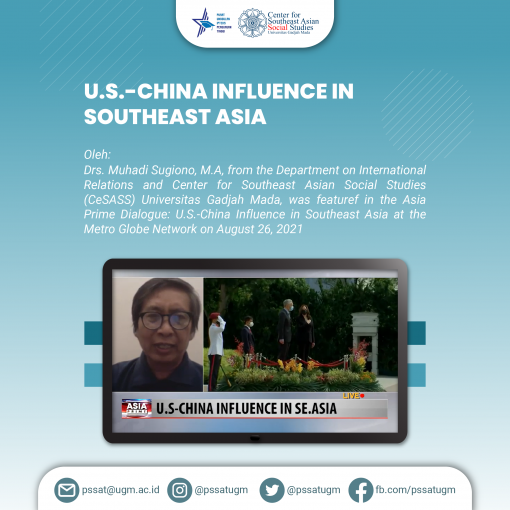
Muhadi Sugiono, from the Department of International Relations and Center for Southeast Asian Social Studies (CESASS), Universitas Gadjah Mada, was featured in the Asia Prime Dialogue: US-China Influence in Southeast Asia at the Metro Globe Network on August 26, 2021.

In the Dialogue with Mrs. Shafiyah F. Muhibat, the Head of International Relation Department of CSIS, Pak Muhadi totally agrees with the Ibu Shafiyah regarding the aim of the Vice President US, Kamala Harris visitation to Southeast Asia. He expressed that there was a hesitation towards the effectiveness of the visitation and appended 3 important points: the trustworthiness toward the US as a reliable partner in Southeast Asia is very low, the US is not able to gain Southeast Asia importance unless they show a concrete policy action as a prove to fulfill their promises, and the US really need to change their point of view to see Southeast Asia as its partner especially in the context of the confrontation with China.

Regarding vaccine diplomacy, Muhadi stated that it should be seen as an initiative by those who need access to the vaccine. The US and European Union were very nationalistic in character regarding the vaccine while China responded very generously to Southeast Asia’s demand for the vaccine. The dialogue also discussed the motive of the US to choose Singapore and Vietnam in their visitation. Muhadi gave his opinion that Singapore was the US’s closest ally and choosing Vietnam was to make sure that the country is on the same side as the US. Muhadi also stated the US move with that visitation has not significantly affected China’s relationship with Southeast Asia.

Full video of the dialogue could be accessed on youtube: https://www.youtube.com/watch?v=zlWC-GkgyTE

Leave A Comment Cancel reply

Your email address will not be published. Required fields are marked *

*

Recent Posts

  • CESASS Chat #47: “Artivism in Indonesia” & “Maritime Dispute in South China Sea”
  • CESASS Chat #46: “Regime Types in Southeast Asia and the Interpretation of ASEAN Norms”
  • Fostering Academic Exchange with Center of Peatland and Disaster Studies, Universitas Riau (CPDS UNRI)
  • CESASS Chat #45: “A Nation Within a City: Contesting Space and Meaning in the Indonesian Capital” & “Perceptions of the Past and Present: What Does Borobudur Represent in the Wider Context of Discussions on Heritage?”
  • Supporting Institutional Efforts toward a Center of Excellence with Pusat Riset Sistem Peradilan Pidana Universitas Brawijaya (PERSADA UB)
Universitas Gadjah Mada

Center for Southeast Asian Social Studies
Universitas Gajah Mada

Gedung PAU, Jl. Teknika Utara
Daerah Istimewa Yogyakarta 55281
pssat@ugm.ac.id
+62 274 589658

Instagram | Twitter | FB Page | Linkedin | Youtube

© Universitas Gadjah Mada

KEBIJAKAN PRIVASI/PRIVACY POLICY