• Tentang UGM
  • IT Center
  • English
    • Bahasa Indonesia
    • English
Universitas Gadjah Mada Center for Southeast Asian Social Studies
Universitas Gajah Mada
  • Home
  • About Us
    • Overview
    • Researcher
    • Partner Researcher
    • Partner Institution
    • Library
  • Research
  • Program
    • International Conference
    • SUMMER COURSE
    • CESASS Research Fellowship
    • INTERNSHIP
    • CESASS TALK
    • CESASS Chat
    • SEA Movie
    • Workshop
  • Publication
    • Journal
    • Book
    • Proceeding
    • Policy Brief
  • Academic Essay
    • Culture & Linguistics
    • Digital Society
    • Economic and Social Welfare
    • Education
    • Media & Communication Studies
    • Law & Human Rights
    • Politics and International Relations
    • Article Guidelines
  • Home
  • Post by
  • page. 33
Post by :

pssat

School of Peace: Understanding ASEAN through Interfaith Dialogue

Academic EssayLaw & Human Rights Saturday, 20 February 2016

It has become a truth that the ASEAN community consists of various cultures, ethnicities and beliefs. Understanding the ASEAN community is clearly inseparable from the differences that exist. In this case, trust that grows and develops becomes part of the community inherent in their lives.

ASEAN became a gathering area and the development of a number of beliefs through trade channels and through colonization in the past. But basically, the ASEAN community itself has existed and has developed a number of beliefs since hundreds or thousands of years before, even its existence continues to be maintained as in indigenous peoples who have faith in nature. read more

Building ASEAN Identity

Academic EssayPolitics and International Relations Monday, 15 February 2016

ASEAN, Association of Southeast Asian Nations, is a geo-political and economic organization of countries located in Southeast Asia, which was formed on 8 August 1967, with signing the Bangkok Declaration by Indonesia, Malaysia, Philippines, Singapore and Thailand. As set out in the ASEAN Declaration, one of the aims and purpose of ASEAN is to accelerate the economic growth, social progress and cultural development in the region through joint endeavours in the spirit of equality and partnership in order to strengthen the foundation for a prosperous and peaceful community of Southeast Asian Nations. read more

Evaluation of Effectiveness of Poverty Reduction Program In 15 Districts / Cities Assisted by SAPA (2012)

research Sunday, 24 January 2016

Collaborating with Center for Rural and Regions Studies UGM and Strategic Alliance for Poverty Reduction, this research was conducted to understand the dynamics that occur in the field associated with poverty reduction programs to find the difficulties encountered in various programs implemented. From this research, it is expected to find alternative strategies that can be used by related stakeholders to jointly improve the effectiveness of poverty reduction programs so that the target of reducing social problems due to poverty can be achieved as expected. read more

Integration in Southeast Asia: Trajectories of Inclusion, Dynamics of Exclusion (SEATIDE)

research Thursday, 14 January 2016

SEATIDE (Integration in Southeast Asia: Trajectories of Inclusion, Dynamics of Exclusion) is an EU FP7-funded project that will make use of a field research based approach to study processes of integration and exclusion in Southeast Asian (SEA) countries. Led by the Ecole francaise d’ Extreme-Orient (EFEO), it will benefit from the resources and expertise of major Asian Studies institutions in SEA and Europe, as well as the unique EFEO network of 10 field centres located in SEA.

  1. Main scientific objective

Integrative processes offer the promise of economic and cultural development, the free movement of people, the promotion of citizenship and knowledge networks with extensive links with the wider world. At the same time, failure to take advantage of these benefits can result in processes of exclusion that undermine national/regional frameworks, and entail risks in the fields of human development/security, including the danger of framework disintegration. In examining these processes, SEATIDE s research will be informed by an awareness that dynamics of exclusion should be studied in tandem with dynamics of inclusion to produce holistic analyses of integrative processes and their contemporary forms, which take into account long-term local perspectives. read more

Indonesia & Second Track Diplomacy: South China Sea Dispute Settlement (2015)

research Thursday, 14 January 2016

Dispute cases that occur in the South China Sea region are one of the most complicated cases of territorial disputes that have ever occurred in the Southeast Asia region. This dispute not only involved several parties at once, namely Brunei Darussalam, the Philippines, Malaysia, China, Taiwan and Vietnam but also included several issues related to overlapping territorial claims and the withdrawal of sea boundaries in the region. Although at present the dispute in the South China Sea is relatively peaceful, the fact that the dispute has not been resolved completely enables the occurrence of frictions or even military confrontation in the future. Even if we look at the trends that have occurred over the past five years, the tension that arises between the disputing parties shows a higher level than in the previous decade. Therefore it is very necessary for a clear peace settlement framework to avoid the situation worsening in the future. read more

Cassava for Food Sovereignty: Collaborative Studies (2015)

research Thursday, 14 January 2016

This research is a part of superior research of college entitled “Cassava for Food Sovereignty: Collaborative Study” conducted by 10 (ten) study centers under Institute of Research and Community Service (LPPM) Universitas Gadjah Mada (UGM) Yogyakarta. This collaborative research started from the desire to develop the spirit of mutual cooperation studying food security and energy sovereignty, particularly those related to cassava as an alternative food for the sake of national food security. Furthermore, this collaborative research is expected to contribute comprehensively based on the field of knowledge of each study center for the Indonesian nation at large and the government in particular in the form of policy recommendations related to cassava and food security in Indonesia. read more

Human Rights Violations in Southeast Asia (2010)

research Thursday, 14 January 2016

This study was conducted to report on data collection on human rights violations in Southeast Asia that occurred throughout 2010. The countries that are the focus of research are Brunei, Philippines, Indonesia, Cambodia, Laos, Malaysia, Myanmar, Singapore and Thailand. This research seeks to emphasize the importance of the issue of human rights violations for the democratization process in Southeast Asia. Human rights violations are important to note because the high – low levels of human rights violations are often closely related to the quality of a country ‘s democracy. Certainly democracy is a far more complicated issue than the extent of human rights abuses. However, it is not always the case that the implementation of human rights in a country is linear with the quality of democracy, but it is able to encourage democratization process in a more perfect form, because in this situation the public has more awareness about the fulfillment of their rights so they are able to participate in the process development of the country through the channeling of its aspirations. Thus, the data generated by this study may provide some sort of preliminary assessment of the course of democratization especially in countries such as the Philippines, Indonesia, Malaysia, Singapore and Thailand. The same research report also provides a rough idea of the level of coercion and political exclusion in countries such as Brunei, Cambodia, Laos, Myanmar and Vietnam. read more

Higher Education in Facing the ASEAN Economic Community

Academic EssayEducation Monday, 11 January 2016

The challenges of open competition because globalization is a challenge for all individuals and also the state in carrying out its functions as an institution that regulates the life of the nation and state in achieving prosperity. Globalization and connectivity make someone sneeze in the European hemisphere and cause flu for others in Asia. More specifically, the real challenge currently faced by ASEAN countries is open competition which is a consequence of the suppression of Asian Charter contracts by leaders of ASEAN countries on December 15, 2008. Cooperation agreements that resemble the union of European countries within the European Union making the movement of goods, people, and money become unhindered by territorial and political boundaries (borderless) this was then popularly known as the Asian Community which began to be effectively implemented in 2015. read more

Higher Education in Facing ASEAN Economic Community

Academic EssayEducation Monday, 11 January 2016

The challenge of open competition because of globalization become the challenge for all and also countries in running its function as an institution that regulate the life of nation and state in achieving prosperity. Globalization and connectivity make one’s sneeze in the European hemisphere cause flu for others in Asia. More specifically, the real challenge currently faced by ASEAN countries is the open competition which is the consequence of the suppression of Asian Charter contract by the leaders of ASEAN countries on December 15, 2008. The cooperation agreement that resembles the unity of European countries in the EU makes the movement of goods, people, and money become without obstruction of territorial and political boundaries (border-less) is then popularly known as the Asian Community which began effective implementation in 2015. read more

[SEA Talk # 1] Mass Media and Construction of ASEAN Community

ActivitySEA Talk_eng Wednesday, 30 December 2015

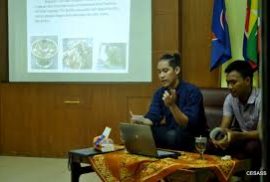
The first PSSAT’s SEA Talk program on May 29, 2015 was titled “Mass Media and ASEAN Community Construction”. Dr. Phil. Hermin Indah Wahyuni, M.Si, head of PSSAT, became the speaker that afternoon. According to her, the mass media now is not fully concerned about the importance of the ASEAN Economic Community (MEA). Mass media, in this case journalists, need to be more in knowing this issue so that it is not only becoming a discourse on the level of the elite alone but this information can be up to the community in Southeast Asia itself. read more

1…31323334

Recent Posts

  • CESASS Chat #46: “Regime Types in Southeast Asia and the Interpretation of ASEAN Norms”
  • Fostering Academic Exchange with Center of Peatland and Disaster Studies, Universitas Riau (CPDS UNRI)
  • CESASS Chat #45: “A Nation Within a City: Contesting Space and Meaning in the Indonesian Capital” & “Perceptions of the Past and Present: What Does Borobudur Represent in the Wider Context of Discussions on Heritage?”
  • Supporting Institutional Efforts toward a Center of Excellence with Pusat Riset Sistem Peradilan Pidana Universitas Brawijaya (PERSADA UB)
  • Book Chapter: “Popular Culture in Cross-Cultural Understanding: Roles, Challenges, and Opportunities”
Universitas Gadjah Mada

Center for Southeast Asian Social Studies
Universitas Gajah Mada

Gedung PAU, Jl. Teknika Utara
Daerah Istimewa Yogyakarta 55281
pssat@ugm.ac.id
+62 274 589658

Instagram | Twitter | FB Page | Linkedin | Youtube

© Universitas Gadjah Mada

KEBIJAKAN PRIVASI/PRIVACY POLICY