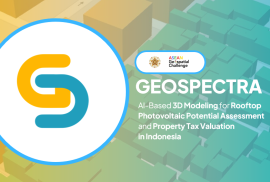
Yogyakarta, Febuary 3, 2026 — Center for Southeast Asian Social Studies at Universitas Gadjah Mada (CESASS UGM) hosted a discussion forum with the AInsightGeo research team as part of an interdisciplinary dialogue connecting geospatial innovation with socio-economic development in Southeast Asia. The forum was held under the CESASS Chat series, titled “GeoSpectra: AI-Based Geospatial Modelling for Rooftop Photovoltaic Assessment and Property Tax Valuation in Indonesia”, and explored the role of AI-based geospatial modeling in addressing urban sustainability challenges.
Intern’s Activities
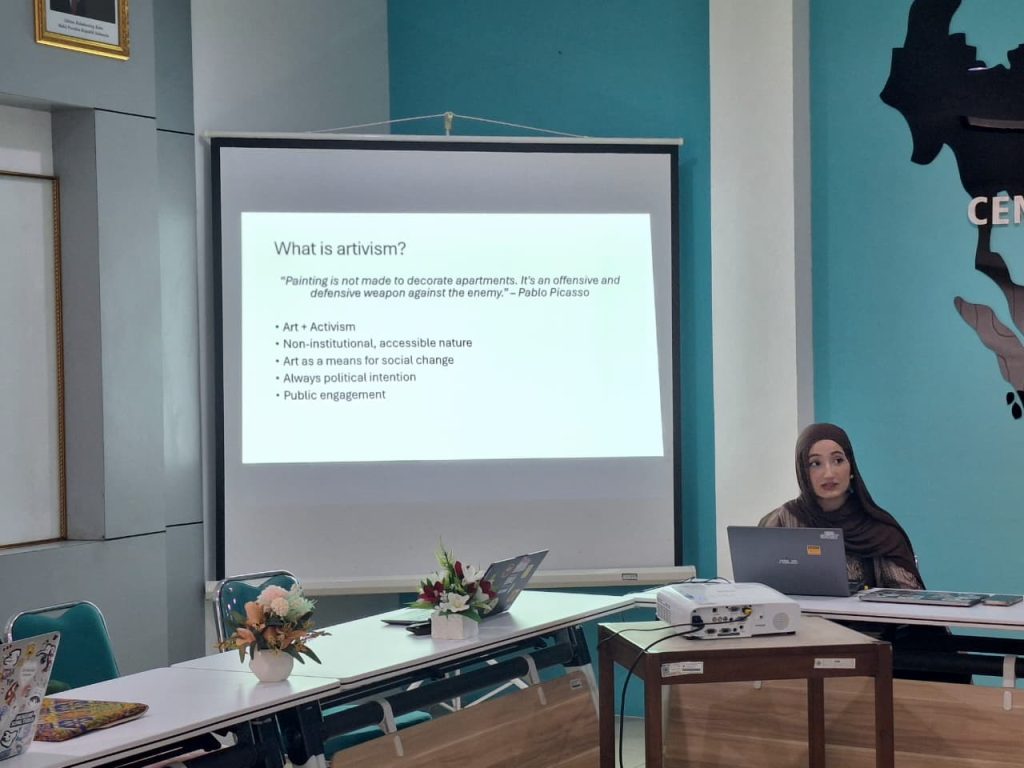
Yogyakarta, January 15, 2026 — Center for Southeast Asian Social Studies at Universitas Gadjah Mada (CESASS UGM) is back with CESASS Chat #47. Kicking off the first CESASS Chat of the year, the session featured Hüdanur Yildirim (Culture, Organisation & Management, Vrije Universiteit Amsterdam) and Farrel Pradana Widodo (International Relations, Universitas Islam Indonesia).

In the session called “Artivism in Indonesia”, Hüda explored artivism as the intersection of art and activism, asking how art functions as a form of political resistance and soft power in Indonesia, and how this role has evolved over time.
Yogyakarta, December 18, 2025 — “How do political systems shape the way regional norms are practiced?” This question anchored CESASS Chat #46 hosted by the Center for Southeast Asian Social Studies, Universitas Gadjah Mada (CESASS UGM), featuring Michael Alexander Budiman (International Relations, Satya Wacana Christian University).
In his Chat, “Regime Types in Southeast Asia and the Interpretation of ASEAN Norms”, Michael introduced ASEAN as a regional organization built on shared behavioral norms—such as sovereignty, non-interference, peaceful conflict resolution, and non-use of force—as well as procedural norms of consultation and consensus. While these principles are often portrayed as fixed and uniformly applied, he demonstrated that their interpretation varies widely across member states.
Yogyakarta, December 12, 2025 — CESASS Chat #45, hosted by the Center for Southeast Asian Social Studies, Universitas Gadjah Mada (CESASS UGM), brought together Rosie Bendo (Law and Indonesian Language, Australian National University) and Shaneeva Bean (South and Southeast Asian Studies, Leiden University) to discuss how space and heritage in Indonesia are continuously shaped, contested, and redefined by historical, political, and social dynamics.

Rosie’s Chat revolved around a central question: “Who has the right to the city, and who is excluded in the name of national development?”
Yogyakarta, November 28, 2025 — “Aquaculture and mangrove clearance sit at the intersection of Indonesia’s primary development challenges: food insecurity, intransigent poverty, and climate instability.” This issue formed the central discussion of CESASS-CHAT #4, hosted by the Center for Southeast Asian Social Studies at Universitas Gadjah Mada (CESASS UGM).
The session featured Edward Atkinson, a student of International Security Studies and Development Studies at the Australian National University (ANU). He delivered a presentation on the topic of “Aquaculture and Climate Resilience in Indonesia”.
Yogyakarta, November 4–5, 2025 — As a multidisciplinary research center, the Center for Southeast Asian Social Studies at Universitas Gadjah Mada (CESASS UGM) offers interns in the CESASS Internship Program diverse learning experiences. In addition to participating in CESASS’s internal activities, interns are encouraged to take part in various external engagements, such as public lectures, seminars, academic fairs, training, cultural events, exhibitions, and conferences.
This time, one of the international interns from the Vrije Universiteit, Netherlands, Hüdanur Yildirim, had the opportunity to participate in the 13th International Graduate Students and Scholars’ Conference in Indonesia (IGSSCI) with the theme “Navigating the Future: Strengthening Resilience Through Global Collaboration Towards World Peace”, hosted by the Graduate School UGM and held on 4–5 November 2025.
Yogyakarta, November 14, 2025 — Center for Southeast Asian Social Studies, Universitas Gadjah Mada (CESASS UGM), welcomed representatives from the Australian Consortium for In-Country Indonesian Studies (ACICIS) for a coordination meeting to review the ongoing internship program hosted under the CESASS Internship Program.
This semester, three ACICIS students are undertaking their internship at CESASS through the Flexible Language Immersion Program (FLIP). As the internship reached its halfway point, the meeting served as an opportunity for both institutions to review the students’ activities, evaluate their progress, identify challenges, and discuss areas for improvement.
On September 12, 2025, Center for Southeast Asian Social Studies at Universitas Gadjah Mada (CESASS UGM) successfully hosted the CESASS-CHAT #3 in a hybrid format, held at the Indonesia Room, CESASS UGM. The session featured Jauza Rifa Abdurrafi, a student of Politics and International Relations at the University of Nottingham. Delivering a presentation titled “Talent Migration and Economic Growth in Indonesia: Balancing Brain Drain, Brain Gain, and Institutional Capacity,” Jauza shed light on the realities of Indonesian migration and its significance for the nation’s future development.
Yogyakarta, June 3, 2025 — CESASS Talk Series #5 was held online, featuring Dr. Tufan Kutay Boran from the Department of Area Studies, Social Sciences University of Ankara, Türkiye, who delivered a presentation on “How Indonesian Political Parties and Islamic Organizations Influence Foreign Policy Making”. The session was moderated by Dr. phil. Vissia Ita Yulianto, guiding the discussion and Q&A with participants from diverse academic backgrounds, including international young scholars.
Yogyakarta, May 19, 2025 — A presentation focusing on the intricacy and geopolitical importance of underwater sea cables in Southeast Asia was conducted at the Center for Southeast Asian Studies at Universitas Gadjah Mada (CESASS UGM). The presentation was conducted by Cameron Regan, an International Relations student at the University of Queensland.
Recent events regarding underwater cable malfunctions in areas such as the South China Sea and Java Sea inspired the presentation’s research focus. Specifically, the political and economic impact of these malfunctions in the Southeast Asian and Indo-Pacific spheres of influence. Underwater fibre optic cable systems provide approximately 95% of the worlds’ internet connectivity, ensuring split-second speed of financial transactions and a functional digital economy worth immeasurable value. This means those states which manufacture and regulate these cables in international waters can manipulate encrypted global communication networks.