• Tentang UGM
  • IT Center
  • English
    • Bahasa Indonesia
    • English
Universitas Gadjah Mada Center for Southeast Asian Social Studies
Universitas Gajah Mada
  • Home
  • About Us
    • Overview
    • Researcher
    • Partner Researcher
    • Partner Institution
    • Library
  • Research
  • Program
    • International Conference
    • SUMMER COURSE
    • CESASS Research Fellowship
    • INTERNSHIP
    • CESASS TALK
    • CESASS Chat
    • CESASS Vodcast
    • SEA Movie
    • Workshop
  • Publication
    • Journal
    • Book
    • Proceeding
    • Policy Brief
  • Academic Essay
    • Culture & Linguistics
    • Digital Society
    • Economic and Social Welfare
    • Education
    • Media & Communication Studies
    • Law & Human Rights
    • Politics and International Relations
    • Article Guidelines
  • Home
  • activities
  • CESASS CHAT #4: “Aquaculture and Climate Resilience in Indonesia” by Edward Atkinson

CESASS CHAT #4: “Aquaculture and Climate Resilience in Indonesia” by Edward Atkinson

  • activities, Activity, CESASS Chat - eng, Intern's Activities, internship, short news
  • 2 December 2025, 10.14
  • Oleh: mellyananungki
  • 0

Yogyakarta, November 28, 2025 — “Aquaculture and mangrove clearance sit at the intersection of Indonesia’s primary development challenges: food insecurity, intransigent poverty, and climate instability.” This issue formed the central discussion of CESASS-CHAT #4, hosted by the Center for Southeast Asian Social Studies at Universitas Gadjah Mada (CESASS UGM).

The session featured Edward Atkinson, a student of International Security Studies and Development Studies at the Australian National University (ANU). He delivered a presentation on the topic of “Aquaculture and Climate Resilience in Indonesia”. 
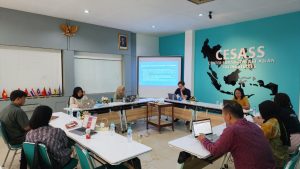
The presentation specifically focused on the relationship between the growth of the aquacultural sector and the destruction of mangrove forests to accommodate this expansion. The implications of this process on Indonesia’s ability to develop climate resilience were then discussed in consideration of the ecological value of mangrove forests as natural mitigators of coastal erosion and flooding.

The tension between the development of Indonesia’s aquacultural sector to the detriment of mangrove ecosystems was framed by Edward as an issue of competing land usage priorities. Furthermore, Edward argued that the competition between these interests has been compounded by inadequate government regulation and enforcement as well as broader macro-economic trends.

The integration of mangrove ecosystems within innovative aquacultural models based on traditional Indonesian silvofishery practices, for example, empang parit or komplang systems, was proposed as a potential means to alleviate pressures on mangrove forests from aquacultural expansion. 

Edward’s presentation was followed by a Q&A session during which questions regarding government capacity and the possible constraints to the implementation of policy solutions were discussed.


Reporter: CESASS Team

Editor: Mellyana Nungki Pramitha

Leave A Comment Cancel reply

Your email address will not be published. Required fields are marked *

*

Recent Posts

  • CESASS Team Conducts Field Research on Socio-Cultural Transformation and Environmental Justice in East Kalimantan
  • CESASS Chat #48 “GeoSpectra” by AInsightGeo Team
  • Bridging Academic Silos Through Collaborative Dialogue
  • CESASS Chat #47: “Artivism in Indonesia” & “Maritime Dispute in South China Sea”
  • CESASS Chat #46: “Regime Types in Southeast Asia and the Interpretation of ASEAN Norms”
Universitas Gadjah Mada

Center for Southeast Asian Social Studies
Universitas Gajah Mada

Gedung PAU, Jl. Teknika Utara
Daerah Istimewa Yogyakarta 55281
pssat@ugm.ac.id
+62 274 589658

Instagram | Twitter | FB Page | Linkedin | Youtube

© Universitas Gadjah Mada

KEBIJAKAN PRIVASI/PRIVACY POLICY