
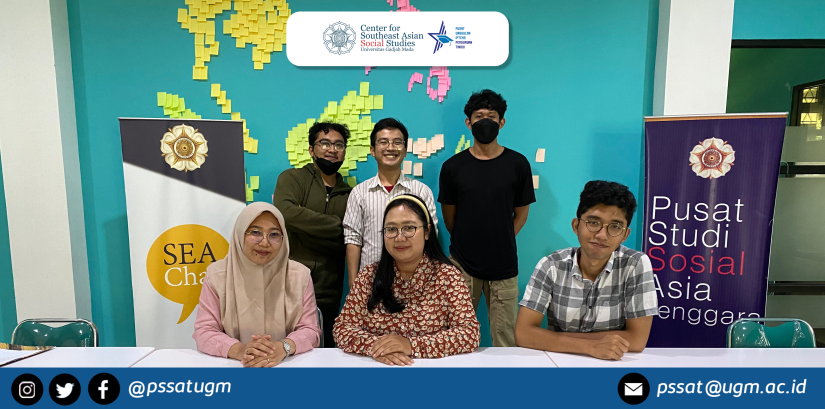
On January, 24th 2023 (GMT +7) Center of Southeast Asian Social Studies (CESASS) Universitas Gadjah Mada held the agenda called SEA CHAT. The #SEACHAT37 entitled ‘If I Was the Director: Breaking the Eurocentric in Postcolonialism and Transnational of Film De Oost’ was presenting by Syfa Amelia as internship student at CESASS from Master Program in Communication Science, Universitas Gadjah Mada.
The discussion was started from Syfa that explained the synopsis of the movie De Oost (The East). This movie was directed by Jim Taihuttu and released in 2020 but it’s still interesting to be discussed until today. Syfa explained the critics from her perspective as a part of post-colony country. Those, from her analysis the movie De Oost (The East) was glorifying the white perspective which made the movie looks un-relevant to the history. Further, cited from Syfa’s explanation she found that there were some scenes that stereotyping Indonesia. Other than that, Syfa choose the movie De Oost (The East) because it is still has its correlation to the Southeast Asian country, especially Indonesia.
Syfa as the presenter on the #SEACHAT37 also explained the important point of postcolonialism theory that can be analyzed in a movie. Other than that, she hoped that from this topic the participants or society can understand the use of postcolonial critics in the movie. Those, we can understand that movie has its goals not only for entertain the consumer but also for the media of commodity, history, hegemony and etc. Moreover, Syfa explained her findings on the movie De Oost (The East) about the meaning of the setting of place, the different color in some scenes such as contrast to the yellow tone, blue or etc. The previous findings have its function to define the movie and its correlation to the postcolonial terms.
The topic on #SEACHAT37 was invited some questions from the participants and interns. The question that turned to the floor such as, how the society can identify the ‘postcolonial value’ in the movie? Then, we can analyze the movie instead for the entertainment media. Also, is there any indicator we can use to determine a movie to postcolonial analysis? In add, to answer the question Syfa said that actually there is no specific indicator to see a movie with ‘postcolonial value’ but then we can see if there are two countries or more in a war to get an authority or power. An example of this movie is Indonesia and Western countries. Furthermore, Syfa said that a movie actually has its goals for entertaining the viewers but in the other part a movie also has its goals to deliver a value, hegemony or maybe serve a fictional or add a factual history. Although, the postcolonial value will find to the viewer if the viewer know about ‘postcolonial theory’ in the movie.
In last, before #SEACHAT37 end there were also some questions that turn to Syfa. For the further information about SEA CHAT and the upcoming agenda in the Center of Southeast Asia Social Studies, please to check the official account CESSAS on @pssatugm or on the website http://pssat.ugm.ac.id/.
By: Dyny Wahyu Seputri