• Tentang UGM
  • IT Center
  • English
    • Bahasa Indonesia
    • English
Universitas Gadjah Mada Center for Southeast Asian Social Studies
Universitas Gajah Mada
  • Home
  • About Us
    • Overview
    • Researcher
    • Partner Researcher
    • Partner Institution
    • Library
  • Research
  • Program
    • International Conference
    • SUMMER COURSE
    • CESASS Research Fellowship
    • INTERNSHIP
    • CESASS TALK
    • CESASS Chat
    • CESASS Vodcast
    • SEA Movie
    • Workshop
  • Publication
    • Journal
    • Book
    • Proceeding
    • Policy Brief
  • Academic Essay
    • Culture & Linguistics
    • Digital Society
    • Economic and Social Welfare
    • Education
    • Media & Communication Studies
    • Law & Human Rights
    • Politics and International Relations
    • Article Guidelines
  • Home
  • activities
  • CESASS Chat #46: “Regime Types in Southeast Asia and the Interpretation of ASEAN Norms”

CESASS Chat #46: “Regime Types in Southeast Asia and the Interpretation of ASEAN Norms”

  • activities, Activity, CESASS Chat - eng, Intern's Activities, internship
  • 22 December 2025, 14.21
  • Oleh: mellyananungki
  • 0

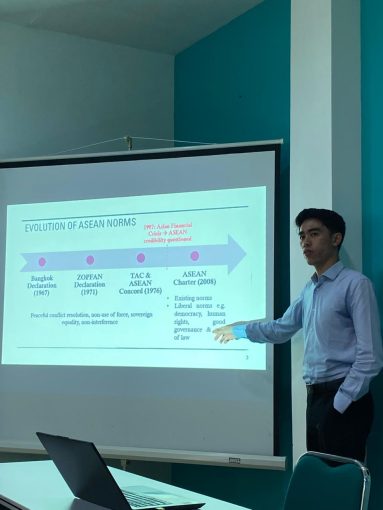
Yogyakarta, December 18, 2025 — “How do political systems shape the way regional norms are practiced?” This question anchored CESASS Chat #46 hosted by the Center for Southeast Asian Social Studies, Universitas Gadjah Mada (CESASS UGM), featuring Michael Alexander Budiman (International Relations, Satya Wacana Christian University).

In his Chat, “Regime Types in Southeast Asia and the Interpretation of ASEAN Norms”, Michael introduced ASEAN as a regional organization built on shared behavioral norms—such as sovereignty, non-interference, peaceful conflict resolution, and non-use of force—as well as procedural norms of consultation and consensus. While these principles are often portrayed as fixed and uniformly applied, he demonstrated that their interpretation varies widely across member states.

Using case studies such as the 1997 Asian Financial Crisis and the post-2021 Myanmar coup, he illustrated how regional crises pressure ASEAN’s normative framework, revealing tensions between ideals and political realities.

His Chat sparked an engaging Q&A session, centering on a pressing debate: “Does ASEAN belong to the broader society, or is it dominated by the elite?”

Drawing from his undergraduate thesis proposal, the Chat offers a glimpse of research, with its findings hoped to be fully presented in the near future.


Reporter: Mellyana Nungki Pramitha

Leave A Comment Cancel reply

Your email address will not be published. Required fields are marked *

*

Recent Posts

  • Strengthening Regional Studies Through Convergent Scholarship
  • Exploring the Social Dimensions of Waste: Insights from Dr. Viola Schreer
  • CESASS Team Conducts Field Research on Socio-Cultural Transformation and Environmental Justice in East Kalimantan
  • CESASS Chat #48 “GeoSpectra” by AInsightGeo Team
  • Bridging Academic Silos Through Collaborative Dialogue
Universitas Gadjah Mada

Center for Southeast Asian Social Studies
Universitas Gajah Mada

Gedung PAU, Jl. Teknika Utara
Daerah Istimewa Yogyakarta 55281
pssat@ugm.ac.id
+62 274 589658

Instagram | Twitter | FB Page | Linkedin | Youtube

© Universitas Gadjah Mada

KEBIJAKAN PRIVASI/PRIVACY POLICY