
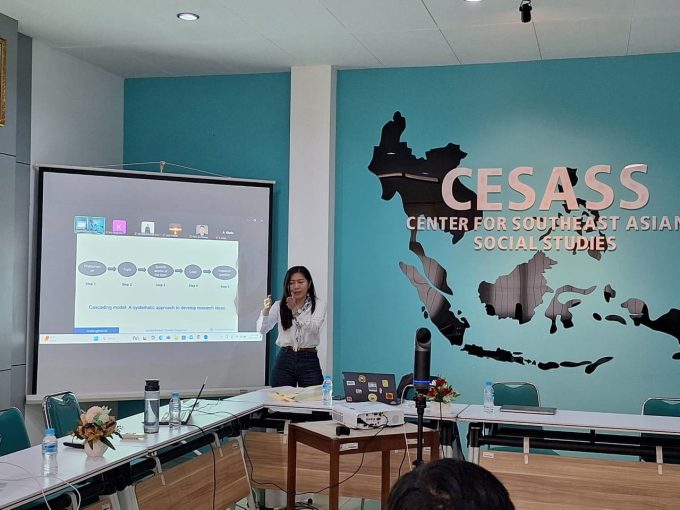
Yogyakarta, October 15, 2025 — “How can we avoid unclear research objectives?”
This was the thought-provoking question posed by Dr. Indri Dwi Apriliyanti as she helped participants sharpen their ability to craft clear and focused research questions.
Center for Southeast Asian Social Studies at Universitas Gadjah Mada (CESASS UGM) successfully held a workshop on Academic Writing titled “Techniques and Ethics: Expanding Publication Opportunities in Scopus Indexing Journal,” bringing together participants from diverse academic backgrounds, such as Universitas Jenderal Soedirman, Universitas Brawijaya, Universitas Airlangga, Universitas Sanata Dharma, UIN Sunan Ampel Surabaya, and Universitas Lambung Mangkurat, to strengthen their research and writing skills.
The day began with a warm welcome and an introduction to the program, followed by an engaging session led by Dr. Indri Dwi Apriliyanti titled “Why Clear Thinking Matters.” Dr. Indri emphasized that clear thinking is fundamental to every stage of the research process—helping scholars make informed decisions, avoid common pitfalls, and produce well-structured and persuasive academic work. Participants received practical guidance on avoiding biases, developing coherent arguments, and maintaining clarity throughout their writing.
In her presentation, Dr. Indri guided participants through the process of identifying and refining research ideas. She elaborated on the distinctions between a phenomenon, topic, and case, as well as demonstrated how narrowing the research focus is crucial to formulating a clear and impactful study. Through the introduction of the cascading model, she provided a systematic framework for developing research ideas, supported by real-world examples of innovation in public service. The session also covered strategies for identifying different types of research gaps—ranging from theoretical and phenomenon-based to knowledge and empirical—encouraging participants to approach their academic inquiries with depth and precision.
The second and last session of the day, led by Dr. Phil Vissia Ita Yulianto, titled “Write to Be Read: Editorial Standards Are Not Optional,” focused on the importance of meeting editorial and publication standards in academic writing. Dr. Ita underscored that adherence to these standards is not merely procedural but essential for ensuring credibility, dissemination, and impact. She also highlighted that manuscripts failing to meet editorial expectations often suffer from poor structure and grammar, vague or anecdotal claims without evidence, weak or absent analysis, as well as the use of informal or overly simplistic language.
During this workshop, participants gained valuable insights into the editorial and review process—from submission and desk screening to revisions and proofreading, which was a reminder of the importance of precision and rigor in scholarly communication. The workshop concluded with an inspiring message: to write with purpose, think critically, and uphold integrity in every stage of academic work.
Reporter: Hudanur Yildirim