
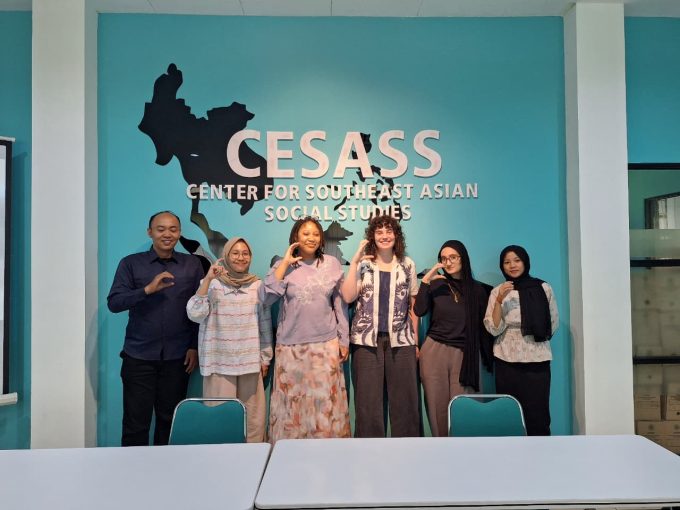
Yogyakarta, December 12, 2025 — CESASS Chat #45, hosted by the Center for Southeast Asian Social Studies, Universitas Gadjah Mada (CESASS UGM), brought together Rosie Bendo (Law and Indonesian Language, Australian National University) and Shaneeva Bean (South and Southeast Asian Studies, Leiden University) to discuss how space and heritage in Indonesia are continuously shaped, contested, and redefined by historical, political, and social dynamics.

Rosie’s Chat revolved around a central question: “Who has the right to the city, and who is excluded in the name of national development?”
In “A Nation Within a City: Contesting Space and Meaning in the Indonesian Capital”, she framed Jakarta not simply as Indonesia’s capital but indeed a contested political, cultural, and imaginative space through which the nation itself is produced. Drawing on literary reflections by Pramoedya Ananta Toer and key theoretical insights from Benedict Anderson, Thongchai Winichakul, Partha Chatterjee, and Abidin Kusno, she examined how Jakarta has come to embody both the promise and failure of the Indonesian national project.
Tracing historical struggles over physical and symbolic space, from colonial urban planning and post-independence modernization to the authoritarian governance of the late New Order and the critical voices that emerged after 1998, she paid particular attention to the regulation and removal of kampungs, street vendors, informal workers, and “third spaces”. This revealed how architecture, urban infrastructure, and monuments are mobilized as tools of power.
By asking “If Jakarta could speak, what would it say?”, she invited a rethinking of urban space as a site of political struggle, memory, and possibility in contemporary Indonesia.

Shaneeva challenged the audience to look beyond Borobudur as a silent monument of the past and consider how its meaning has been continually remade.
In her Chat, “Perceptions of the Past and Present: What Does Borobudur Represent in the Wider Context of Discussions on Heritage?”, she traced how Borobudur’s meaning has shifted over time, from a symbol of a “glorious” past to an important marker of national identity, and eventually to a form of living heritage negotiated by the government, local communities, religious groups, and international institutions such as UNESCO.
She highlighted how changing policies shaped Borobudur’s management, particularly during the New Order, when centralized control framed heritage as a tool for tourism and economic growth, then reshaping relationships with surrounding communities through spatial regulation, restricted access, and the marginalization of local voices. Turning to the Reform era, she noted a renewed emphasis on community involvement and local values, while emphasizing that these shifts remain contested as Borobudur continues to be promoted as a “super-priority” tourism destination.
Through her Chat, Shaneeva demonstrated that heritage is not simply inherited from the past but actively produced in the present through negotiations over power, identity, and management.
Reporter: CESASS Team
Editor: Mellyana Nungki Pramitha