
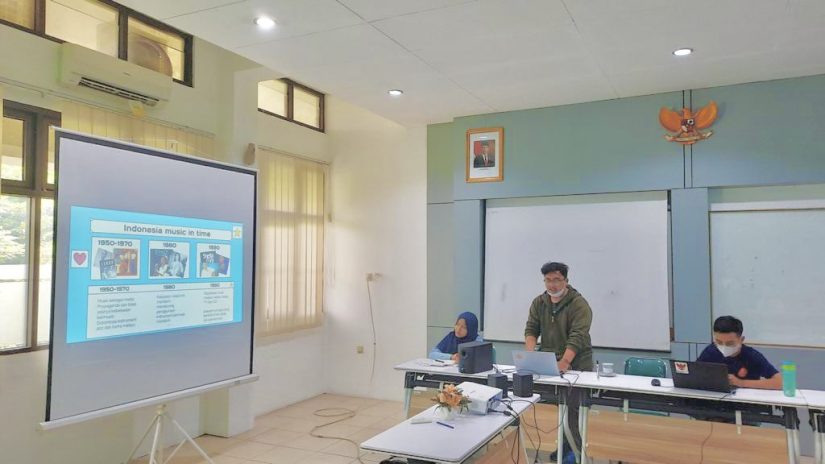
Last Friday (30/9), Center of South East Social Studies (CESASS) held a sharing session by an Indonesian Intern about popular culture in Indonesia such as music, movie, fashion, and memes. This sharing session was attended by CESASS interns both local and Russian. This sharing session was presented by Ilham Ramadhan and Dinda Bariqul Zahfa as an intern at CESASS.
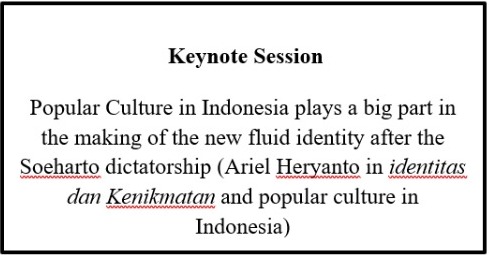
Ilham Ramadhan as the first presenter explained music and memes in Indonesia and start with the definition of popular culture. Popular culture is a mass production and consumption process of cultural products mainly by the middle and lower-class society. In the Indonesian context, popular culture plays the political, moral, and ideological dynamics in Indonesian society. Music, Film, Fashion, and Memes were chosen in this sharing session to explain the diversity and dynamics of Indonesian popular culture.
Music in Indonesian popular culture plays the role of an expression of Indonesian society and plays a part in Indonesia’s major history. The Indonesian music scene has undergone many changes following the socio-political situation of Indonesia, this creates Indonesia to have various musical decades that characterize the peculiarities of each decade. In this presentation, They categorize Indonesian music into the decade of Indonesian music ranging from 1950-1970s, 1980s, 1990s, 2000s, 2010s, and 2020s.
After the discussion about music in Indonesian popular culture, Ilham continues to discuss Memes in Indonesian popular culture. Memes in Indonesia have a long history ranging in Images and video formats. The use of image format as a memes medium has been used in the newspaper from colonial times like caricatures to the contemporary web like 1CAK (Indonesia meme page like 9gag) and social media platforms like Twitter and Facebook.
The next sharing session was then continued by Dinda Bariqul Zahfa, presenting about Cinema and Fashion in Indonesia’s popular culture. Dinda opened the session with the history of Indonesian cinema. The first step of Indonesian cinema was the production of the Loetoeng Kasaroeng movie. Loetoeng Kasaroeng showed famous folklore from West Java that contains the advice “don’t judge a book from the cover”. Java Film Co house production made this silent, black-white movie with the Dutch director. In the Orde Lama (old order) era, Indonesian movies became the medium of the political propaganda and social movement of Soekarno within his speech “Politics Manifestation”, similar things also happen in the new order era, and Indonesian movies become a pro-government propaganda media. One of the most memorable movies from that time is the G30S/PKI movie that aired every year. The movie described Soeharto as a hero who resolved the Communist Party rebellion rather than focusing on history education. Cinema in this era is dominated by a comedic genre wrapped by social critics and political satire called ‘Warkop’. The comedy group consisting of Dono, Nunu, Kasino, and Indro became an important element to critics of the new order with political satire of Soeharto’s position.
In the reformation era, movie-making is granted freedom, but movie experts called this era “kebablasan” because many horror movies highlight the side of sensuality rather than quality. Sensual movies under the guise of horror, comedy, and drama are symptomatic to the point that they are considered normal.
As for the last segment of Indonesian popular culture, fashion was picked to explain the diversity of the society of Indonesia where The East meets The West, traditional meets the modern era. As in this presentation, there are 3 categories displayed Indonesian popular fashions ranging from urban Muslim fashion, traditional tren, and contemporary brands. This mixed-and-match fashion is commonly found in Indonesian society as an expression of their diverse identity.
This variety of popular cultural influences in Indonesian society plays a role in various expressions of Indonesian society, starting from music, cinema, fashion, and memes. Referencing the Ariel Heryanto Books about popular culture “popular culture in Indonesia tells us about how the political, moral and ideological power, change and reshape the expression of Indonesian society throughout the history of Indonesia as a multicultural diverse nation”.