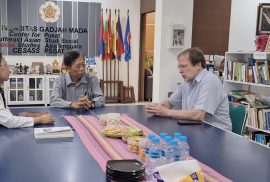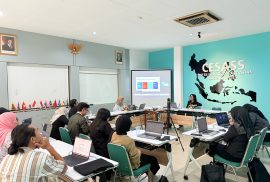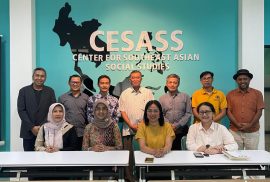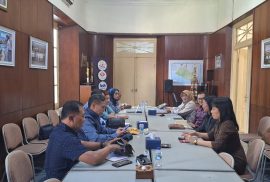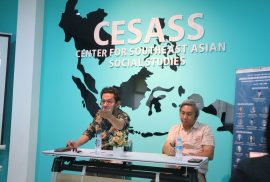
Yogyakarta, Febuary 6, 2026 — Center for Southeast Asian Social Studies at Universitas Gadjah Mada (CESASS UGM) hosted a discussion forum with the AInsightGeo research team as part of an interdisciplinary dialogue connecting geospatial innovation with socio-economic development in Southeast Asia. The forum was held under the CESASS Chat series, titled “GeoSpectra: AI-Based Geospatial Modelling for Rooftop Photovoltaic Assessment and Property Tax Valuation in Indonesia”, and explored the role of AI-based geospatial modeling in addressing urban sustainability challenges.
Activity
Yogyakarta, January 28, 2026 — The Center for Southeast Asian Social Studies at Universitas Gadjah Mada (CESASS UGM) organized a multidisciplinary discussion involving scholars from the Faculty of Engineering and the Faculty of Social and Political Sciences, reaffirming the importance of cross-disciplinary collaboration in responding to contemporary social and technological challenges.
The discussion highlighted the growing interconnection between technology and society, emphasizing that technological innovation both shapes and is shaped by social, political, and cultural contexts. Addressing complex regional and global issues therefore requires collaborative approaches that integrate technical expertise with social and political analysis.
Yogyakarta, January 15, 2026 — Center for Southeast Asian Social Studies at Universitas Gadjah Mada (CESASS UGM) is back with CESASS Chat #47. Kicking off the first CESASS Chat of the year, the session featured Hüdanur Yildirim (Culture, Organisation & Management, Vrije Universiteit Amsterdam) and Farrel Pradana Widodo (International Relations, Universitas Islam Indonesia).

In the session called “Artivism in Indonesia”, Hüda explored artivism as the intersection of art and activism, asking how art functions as a form of political resistance and soft power in Indonesia, and how this role has evolved over time.
Yogyakarta, December 18, 2025 — “How do political systems shape the way regional norms are practiced?” This question anchored CESASS Chat #46 hosted by the Center for Southeast Asian Social Studies, Universitas Gadjah Mada (CESASS UGM), featuring Michael Alexander Budiman (International Relations, Satya Wacana Christian University).
In his Chat, “Regime Types in Southeast Asia and the Interpretation of ASEAN Norms”, Michael introduced ASEAN as a regional organization built on shared behavioral norms—such as sovereignty, non-interference, peaceful conflict resolution, and non-use of force—as well as procedural norms of consultation and consensus. While these principles are often portrayed as fixed and uniformly applied, he demonstrated that their interpretation varies widely across member states.
Yogyakarta, December 15, 2025 — Center for Southeast Asian Social Studies, Universitas Gadjah Mada (CESASS UGM) received a delegation from the Center of Peatland and Disaster Studies, Universitas Riau (CPDS UNRI). Representing the visit was Dr. phil. Vissia Ita Yulianto, Head of Program and Publication at CESASS, and Dr. Arifudin, S.P., M.P., Researcher at CPDS. Dr. Arif’s visit also served as a reunion with CESASS, as he was previously affiliated with the center as a doctoral student from 2016 to 2019.
Yogyakarta, December 12, 2025 — CESASS Chat #45, hosted by the Center for Southeast Asian Social Studies, Universitas Gadjah Mada (CESASS UGM), brought together Rosie Bendo (Law and Indonesian Language, Australian National University) and Shaneeva Bean (South and Southeast Asian Studies, Leiden University) to discuss how space and heritage in Indonesia are continuously shaped, contested, and redefined by historical, political, and social dynamics.

Rosie’s Chat revolved around a central question: “Who has the right to the city, and who is excluded in the name of national development?”
Yogyakarta, December 12, 2025 — Center for Southeast Asian Social Studies, Universitas Gadjah Mada (CESASS UGM) hosted a strategic visit and discussion with Pusat Riset Sistem Peradilan Pidana, Universitas Brawijaya (PERSADA UB). The visit was undertaken as an institutional learning initiative supporting PERSADA UB’s formulation of strategies toward Pusat Unggulan Iptek Perguruan Tinggi (PUI-PT) or Center of Excellence (CoE) under the Ministry of Higher Education, Science, and Technology framework.
Busan, December 2, 2025 — Women scholars and leaders from ASEAN Member Countries (AMCs), including Thailand, Indonesia, the Philippines, Myanmar, Lao, Cambodia, and Vietnam, signed Busan Global Women’s Policy Network. Together with South Korea and the Republic of Kazakhstan, the joint declaration shared a commitment to a sustainable and gender equal future.

Aligned with the UN Sustainable Development Goals—especially Goal 5 (Gender Equality) and Goal 8 (Decent Work and Economic Growth)—the network functions as a collaborative platform to promote women’s rights, economic empowerment, leadership, and inclusive education. It also supports Busan’s vision to become a global hub for international cooperation on women’s development.
Yogyakarta, November 28, 2025 — “Aquaculture and mangrove clearance sit at the intersection of Indonesia’s primary development challenges: food insecurity, intransigent poverty, and climate instability.” This issue formed the central discussion of CESASS-CHAT #4, hosted by the Center for Southeast Asian Social Studies at Universitas Gadjah Mada (CESASS UGM).
The session featured Edward Atkinson, a student of International Security Studies and Development Studies at the Australian National University (ANU). He delivered a presentation on the topic of “Aquaculture and Climate Resilience in Indonesia”.
Yogyakarta, November 17, 2025 — Center for Southeast Asian Social Studies at Universitas Gadjah Mada (CESASS UGM), represented by the Head of the Program and Publication, Dr. phil. Vissia Ita Yulianto, hosted a visit by Dr. Rizanna Rosemary from Pusat Riset Ilmu Sosial dan Budaya (Research Center for Social and Cultural Studies) at Universitas Syiah Kuala (PRISB USK).

Dr. Rizanna introduced USK’s new Master’s Program in Peace and Conflict Resolution (MDRK), rooted in Aceh’s historical experience in peacebuilding and social transformation. She also invited CESASS to collaborate through guest lectures, joint seminars, academic exchanges, or research partnerships.