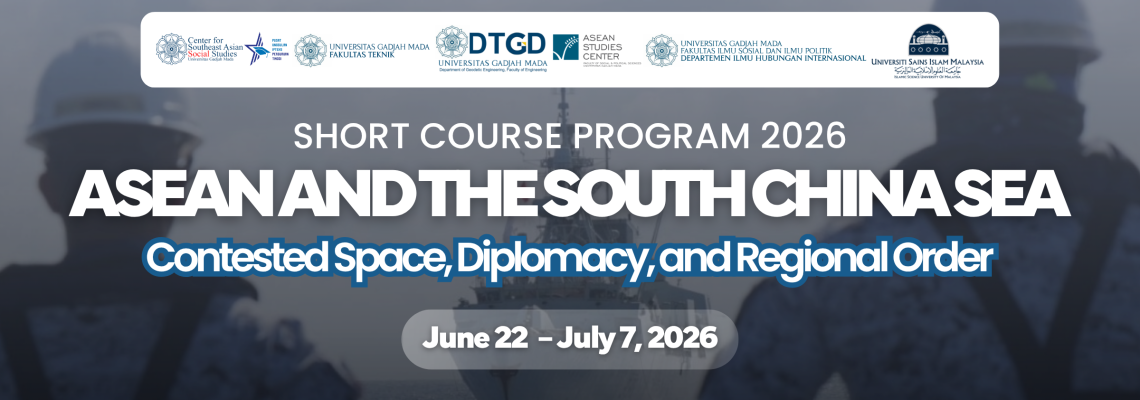
Short Course 2026 “ASEAN and the South China Sea: Contested Space, Diplomacy, and Regional Order”
Program
Background
The South China Sea is a vital international maritime route, rich in natural resources and central to global economic, security, and geopolitical interests. A significant portion of global trade passes through these waters, making regional stability crucial not only for Southeast Asia but also for the global economy. In this context, the Association of Southeast Asian Nations (ASEAN) and its member states hold strategic stakes.
At the same time, the region is marked by overlapping territorial and maritime claims involving several ASEAN member states. These disputes extend beyond sovereignty issues to include access to energy resources, fisheries, and strategic influence, posing serious challenges to regional peace, security, and ASEAN unity. Understanding both ASEAN’s collective stance and the diverse national perspectives of its member states is therefore essential, particularly as ASEAN continues to serve as a key diplomatic platform for managing tensions and promoting peaceful dispute resolution in accordance with international law.
Objectives
To foster greater student interest – particularly among international students – in Southeast Asian studies through interdisciplinary learning on ASEAN and the dynamics of the South China Sea.
To deepen understanding of Southeast Asia by exploring its socio-political dynamics, enriching perspectives and knowledge of the region.
To stimulate more intensive academic discussions on Southeast Asian social studies and encourage the active involvement of international scholars and experts.
To build an international academic community and network grounded in inter-, multi-, and transdisciplinary approaches to Southeast Asian studies.
Learning Outcomes and Curriculum Description
Participants are expected to develop a comprehensive understanding of Southeast Asian studies through the central theme of the course.
Participants will be able to construct critical arguments on Southeast Asian issues, both in territorial and broader regional dynamics, particularly from socio-political, legal, and economic perspectives.
Participants are expected to produce an academic paper as part of their final assignment.
The curriculum consists of five main modules:
Regional Stability and Conflict Management
Major Power Involvement
ASEAN–China Negotiation
National Perspectives within ASEAN Member Countries (AMCs)
Non-Traditional Security
Participants
Eligible Participants
Undergraduate or graduate students, master’s students, and doctoral students
Researchers, practitioners, or professionals
Benefits
Certificate of participation
Transfer credit (equivalent to 3 credits)
Experience of studying (hybrid) with international lecturers
Networking from all over the world
Speakers
Keynote
Arif Havas Oegroseno, S.H., LL.M.
Wakil Menteri Luar Negeri Republik Indonesia
On-Site Lecturers
I Made Andi Arsana S.T ., M.E., Ph.D.
Universitas Gadjah Mada, Indonesia
Prof. Dr. Farish A. Noor
Universitas Islam Internasional Indonesia
Prof. Dr. Dafri Agussalim, M.A.
Universitas Gadjah Mada, Indonesia
Drs. Muhadi Sugiono, M.A.
Universitas Gadjah Mada, Indonesia
Assoc. Prof. Dr. Hazmi bin Mohd Rusli
Universiti Sains Islam Malaysia
Assoc. Prof. Dr. Li Mingjiang
S. Rajaratnam School of International Studies, Singapore
Assoc. Prof. Dr. Chaiwat Meesanthan
Thammasat University, Thailand
Randy Wirasta Nandyatama, S.I.P., M.Sc., Ph.D.
Universitas Gadjah Mada, Indonesia
Online Lecturers
Prof. Dr. Jay Batongbacal
University of the Philippines College of Law
Assoc. Prof. Dr. Xue Song
Fudan University, China
Prof. Dr. Clive Schofield University of Wollongong, Australia