• Tentang UGM
  • IT Center
  • English
    • Bahasa Indonesia
    • English
Universitas Gadjah Mada Center for Southeast Asian Social Studies
Universitas Gajah Mada
  • Home
  • About Us
    • Overview
    • Researcher
    • Partner Researcher
    • Partner Institution
    • Library
  • Research
  • Program
    • International Conference
    • SUMMER COURSE
    • CESASS Research Fellowship
    • INTERNSHIP
    • CESASS TALK
    • CESASS Chat
    • CESASS Vodcast
    • SEA Movie
    • Workshop
  • Publication
    • Journal
    • Book
    • Proceeding
    • Policy Brief
  • Academic Essay
    • Culture & Linguistics
    • Digital Society
    • Economic and Social Welfare
    • Education
    • Media & Communication Studies
    • Law & Human Rights
    • Politics and International Relations
    • Article Guidelines
  • Home
  • Post by
  • page. 16
Post by :

pssat

The Development of Jokowi’s Plan: Why the Omnibus Law Is Good for the Economy but a Threat to Civil Rights in Indonesia

Academic EssayLaw & Human Rights Thursday, 25 November 2021

Jokowi’s First Development Plan: Infrastructure

Joko Widodo, better known as Jokowi, is in his second period of the presidency in Indonesia, which had, during his first period, he concentrated policy on the development of the Indonesian economy, especially through investment in the development of the development infrastructure (Hill and Negara 2019). Jokowi knows that infrastructure has been the “Achilles Heel” for developing countries like Indonesia, yet he focused on investment, health systems, and education during his second term. The last law on labour, the Omnibus law, was confirmed by the Jokowi administration last October during the COVID-19 pandemic. The new law will administer labour, environmental and investment regulation (Arifin 2021, Mahy 2021) read more

[CALL FOR PARTICIPANTS] MMAT 2021 Summer Course Program : (Re)constructing Southeast Asia MMAT 2021

ActivityConference and Symposium Monday, 13 September 2021

Summer Course Program : (Re)constructing Southeast Asia 

Southeast Asia is not a mere geographical space with a passive role in the international arena. The region instead has been becoming an active agent to engage in the international political discourse that covers the political, economic, social and cultural dynamics, as well as, security issues. The image of Southeast Asia as an actor that is capable of becoming an agent, is reflected in the political decision taken by the leaders of Southeast Asian countries to define and to present themselves as one single community, which is the ASEAN Community, and it has entered into force since 2016.  Ironically, the level of interest and the number of studies conducted by academics regarding Southeast Asia are less developed inside  the region.  read more

The Prevention of Peatland Fires in Indonesia: ‘Law in Action’ to Implement the ASEAN Haze Treaty

Uncategorized Wednesday, 8 September 2021

The Indonesian Journal of Southeast Asian Studies (IKAT) just published the new article written by Myrna A Safitri from the Faculty of Law Pancasila University Jakarta. This journal brings on The Prevention of Peatland Fires in Indonesia: ‘Law in Action’ to Implement the ASEAN Haze Treaty as its title. 

This journal calls attention to Indonesia that carries a vital role in the implementation of the ASEAN Haze Treaty, signed in 2002. The ASEAN Haze Treaty is expected to reduce transboundary haze pollution and improve regional environmental governance. The Indonesian government has improved its regulation and strengthened institutional aspects of peatland protection. However, few studies appointed that these policy changes have impacted fire prevention in degraded peatland ecosystems. Based on the issues, this article would examine the political factors behind the legal and institutional changes in Indonesia’s peatland governance during 2016-2020. It is known that there are six predominant factors in peatland law improvement: strong leadership, improved coordination at the national and sub-national levels, making operational directives, establishing a specialized Government institution dealing with peatland restoration, law enforcement, and the strength of civil society in doing public oversight. read more

SEA CHAT #27: Swimming in Plastic: An Examination into Indonesia’s Waste Management System

Activity Wednesday, 8 September 2021

As the global waste is expected to grow to 3.40 billion tonnes by the same year, the waste management system becomes the most concerning issue especially in Indonesia that is already struggling to deal with the current waste levels. The Center for Southeast Asian Studies (CESASS) of Gadjah Mada University (UGM) on Monday (06-09-2021) held SEA CHAT #27 with the topic of “Swimming in Plastic: An Examination into Indonesia’s Waste Management System”. The discussion was conducted by Mingming Alice Sun, 2nd year BA: Political Science and International Relations & Anthropology and Sociology from the University of Western Australia. read more

[CALL FOR PARTICIPANTS] SEA-MCA 2021 : Rediscovering Southeast Asia Amidst Its Multi-layered Burdens

ActivityConference and Symposium Tuesday, 7 September 2021

Southeast Asia Conference on Media, Cinema, and Art

(SEA-MCA 2021): SEA-MCA 2021 : Rediscovering Southeast Asia Amidst Its Multi-layered Burdens

Description:

Southeast Asian studies have been matured in Western centres and have evolved considerably in the scholarly literature on international relations which continue seeing Southeast Asia as an un(differentiated) object of study. In response, even given the fact that no other region on the globe is more diverse than Southeast Asia, against external forces, Southeast Asian member countries have agreed to establish ASEAN — the Association of Southeast-East Asian Nations — community in 1967. Hence, it encounters rough roads in realizing a greater regional integration with its own considerable staggering problems and domestic fluctuations. To name a few, Asian Economic Community (AEC) is at its critical crossroads, ASEAN also has limited success due to its own non-interference norm and has its institutional nadir in political and security environment towards Myanmar coup and Thailand Junta shaping and slipping democracy into crisis. read more

US-China Influence in Southeast Asia

Uncategorized Wednesday, 1 September 2021

Muhadi Sugiono, from the Department of International Relations and Center for Southeast Asian Social Studies (CESASS), Universitas Gadjah Mada, was featured in the Asia Prime Dialogue: US-China Influence in Southeast Asia at the Metro Globe Network on August 26, 2021.

In the Dialogue with Mrs. Shafiyah F. Muhibat, the Head of International Relation Department of CSIS, Pak Muhadi totally agrees with the Ibu Shafiyah regarding the aim of the Vice President US, Kamala Harris visitation to Southeast Asia. He expressed that there was a hesitation towards the effectiveness of the visitation and appended 3 important points: the trustworthiness toward the US as a reliable partner in Southeast Asia is very low, the US is not able to gain Southeast Asia importance unless they show a concrete policy action as a prove to fulfill their promises, and the US really need to change their point of view to see Southeast Asia as its partner especially in the context of the confrontation with China. read more

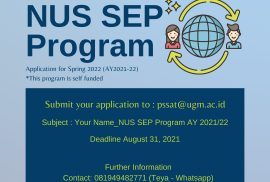
National University of Singapore – Student Exchange Program (SEP) Application for AY2021/2022

Activity Wednesday, 25 August 2021

National University of Singapore – Student Exchange Program (SEP) Application for AY2021/2022

[Self funded]

Greeting from the National University of Singapore!

NUS will once again be running Student Exchange Program (SEP) 2021/22 Semester 2.

We would like to invite you to apply for the programme!

About Student Exchange Programme (SEP) Application

The Student Exchange Programme (SEP) is the largest and most established global programme in NUS. Through the development and management on strategic and sustainable partnerships with universities globally. Under the scheme of Department Level Agreement between UGM CESASS and NUS Department of Southeast Asian Studies. UGM students both undergraduate and post-graduate with interest for Southeast Asian Studies are welcome to do exchange to NUS. read more

Inklusi Sosial di Era Digital (Social Inclusion in the Digital Age)

Digital Society Wednesday, 11 August 2021

Abstrak

Pola relasi-relasi sosial yang tumbuh dan berkembang dalam kehidupan komunitas digital antara lain ditandai oleh kontak langsung, komunikasi yang melibatkan banyak orang (many-to-many communication), keterbukaan pandangan (ide), serta kebebasan berinteraksi. Uraian berikut memetakan perbedaan pandangan tentang dampak pola relasi-relasi tersebut terhadap inklusi sosial atau proses meningkatnya kapasitas akses komunitas pada sumber daya (resources), menguatnya partisipasi mereka dalam formulasi dan eksekusi keputusan publik, serta jalinan kerja sama di antara mereka dalam memanfaatkan dan menciptakan peluang. Di satu sisi, terdapat pandangan yang yakin (optimistic) bahwa relasi-relasi sosial tersebut memiliki dampak signifikan terhadap inklusi sosial karena mampu menghimpun perbendaharaan informasi yang dapat dipergunakan sebagai saluran akses pada sumber daya (resources), dapat dimanfaatkan sebagai pengetahuan (knowledge) untuk menciptakan dan memanfaatkan peluang, serta sebagai sarana mendorong partisipasi politik. Sementara itu, di sisi yang lain, terdapat pandangan yang justru meragukannya (skeptic) karena relasi-relasi sosial tersebut masih menghadapi kendala ketimpangan digital (digital divide) dan literasi sehingga tidak kondusif bagi upaya meningkatkan inklusi sosial. read more

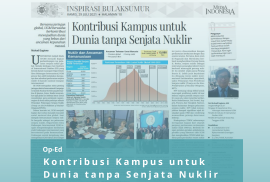
Kontribusi Kampus untuk Dunia tanpa Senjata Nuklir

research Friday, 6 August 2021

An Op-Ed for Media Indonesia in Inspirasi Bulaksumur rubric just published last week (2021/07/29) written by Drs Muhadi Sugiono, MA (Department of International Relation UGM Lecturer, Institute of International Studies UGM and Center for Southeast Asian Social Studies UGM researcher). This Op-Ed calls attention to the role of Higher Education to contribute to the issue of global nuclear disarmament. Through the Institute of International Studies (IIS) research institute, UGM is actively campaigning and advocating for nuclear disarmament on the national and international levels. read more

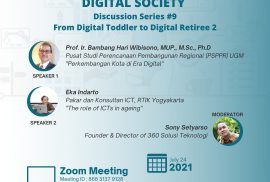
[DIGITAL SOCIETY #9] Discussion Series “From Digital Toddler to Digital Retire #2”

Activity Thursday, 29 July 2021

Sabtu (24/7/21), Pusat Studi Sosial Asia Tenggara (PSSAT) UGM kembali mengadakan webinar Digital Society. Webinar yang bertajuk “From Digital Toddler to Digital Retire #2”, merupakan rangkaian kedua dari diskusi yang dilaksanakan pada bulan lalu. Pada kesempatan kali ini, PSSAT menghadirkan Prof. Ir. Bambang Hari Wibisono dari Pusat Studi Perencanaan Pembangunan Regional (PSPPR) UGM dan Bapak Eka Indarto selaku Praktisi dan Konsultan Teknologi Informasi Komunikasi- RTIK Yogyakarta sebagai pembicara. Diskusi dengan dua topik berbeda akan dielaborasi oleh Bapak Sony Setyarso dari Founder and Director of 360 Solusi Teknologi selaku moderator diskusi. read more

1…1415161718…34

Recent Posts

  • International Partner Supports CESASS in Public Hearing on the Rector’s Regulation on Research Centers
  • UGM Strengthens Role of Research Centers to Support Tridharma and Regional Studies
  • UGM Reinforces Regional Collaboration to Advance Green Skills and Green Jobs
  • Improving Regional Studies Through Convergent Scholarship
  • Discover Indonesia’s Hidden Eco-Islands: A Call for Sustainable Tourism
Universitas Gadjah Mada

Center for Southeast Asian Social Studies
Universitas Gajah Mada

Gedung PAU, Jl. Teknika Utara
Daerah Istimewa Yogyakarta 55281
pssat@ugm.ac.id
+62 274 589658

Instagram | Twitter | FB Page | Linkedin | Youtube

© Universitas Gadjah Mada

KEBIJAKAN PRIVASI/PRIVACY POLICY