
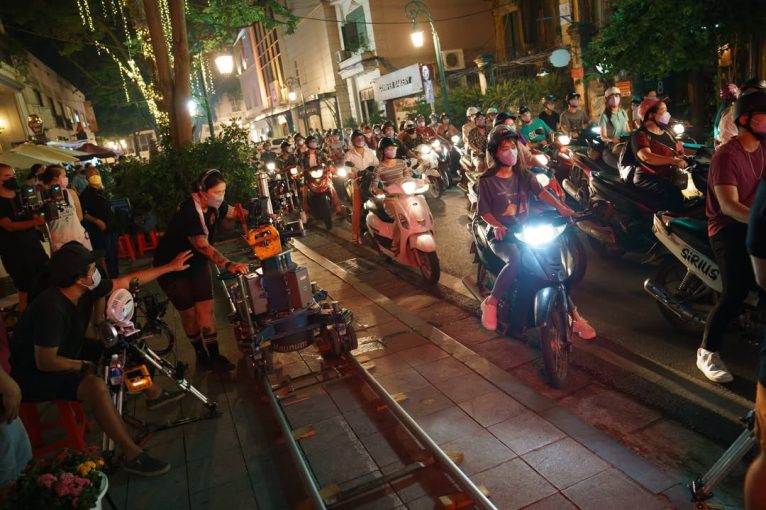
Photo: Instagram post by @oatjo (2023, November 29)
Introduction
Because of the growing influence of entertainment, more tourists are flocking to visit destinations featured in various media, notably films. Reflecting on this, Iwashita (2003) pointed out that film, television, and literature wield significant power in shaping the travel preferences and destination choices of individuals. Through the lens of films, individuals are exposed to a variety of destinations, igniting their interests by portraying the unique attributes and attractions of each one. For instance, the global popularity of South Korean entertainment, known as Hallyu or Korean Wave, has led to a surge in tourism to South Korea, with many fans of Korean dramas visiting filming locations. Not just showcasing breathtaking natural landscapes, films also serve as powerful marketing tools, promoting destinations through captivating narration and visuals (Horrigan, 2009).
Southeast Asia, with its harmonious blend of natural and cultural richness, has become a magnet for tourists from all corners of the globe. As reported by The Diplomat (2024), the six big ASEAN economies—Indonesia, Thailand, Singapore, Malaysia, Vietnam, and the Philippines—welcomed 91 million tourists in 2023, a significant leap from the 39 million recorded in 2022. Thailand took the lead with $30 billion in export earnings, followed by Malaysia, Thailand, Indonesia, the Philippines, and Vietnam in succession. Beyond its appeal to both domestic and international tourists, Southeast Asia entices filmmakers with a wide range of cinematic landscapes. From the classic The Killing Fields (1984) filmed in Thailand to the recent A Tourist’s Guide to Love (2023) in Vietnam, Southeast Asia has established itself as a favorite setting for filmmakers worldwide.
This essay aims to thoroughly explore film-induced tourism, uncovering both its benefits and challenges, while also tracing the governmental approaches in response to this phenomenon.
Film-Induced Tourism
Film-induced tourism is the term used to describe the phenomenon of tourism inspired by films. Here, films are broadened to include not just movies, dramas, and TV shows, but also extended to film festivals, celebrities, and other film-related activities (Du et al., 2019). Films, prompted by the decline in reading habits, have emerged as an important medium for conveying information about nature, culture, and people (Tooke & Baker, 1996; Paprach & Hashim, 2018). Through visual storytelling, films offer a sense of familiarity, shaping perceptions of destinations and ultimately influencing travel decisions. In essence, this is commonly referred to as indirect marketing. Thailand’s films promote the experience of being Thai to foreigners by showing its cuisine and festivals rather than primarily aiming to attract tourists to specific filming locations (Paprach & Hashim, 2018). Therefore, films significantly contribute to sustainable tourism by offering widespread exposure to destinations with minimal cost involvement from the tourism industry, thereby leaving a lasting impact (Liu et al., 2020; Chin & Liu, 2018).
Films representing strong cultures possess the potential to induce tourism (Rahman et al. 2019). Crazy Rich Asians exemplifies the blended culture of Southeast Asia, with the majority of its scenes shot in Singapore and Malaysia. These locations include Cheong Fatt Tze Mansion for the iconic mahjong scene and Langkawi Island for the bachelor party, as well as Newton Food Centre and Bukit Pasoh Road. Similarly, Ta Prohm Temple in Cambodia faced an influx of tourist arrivals, soaring by 150% in 2007, attributed to the popularity of Lara Croft: Tomb Raider (Rahman et al., 2019). Related to Liu et al. (2018), the ancient building might not be captivating enough to grasp attention unless it is paired with a compelling narrative. As a result, the temple has become colloquially known as the Tomb Raider temple. Following the release of Eat, Pray, Love, Ubud saw a similar impact, despite its longstanding reputation as the cultural heart of Bali, with locals warmly welcoming and eager to share their everyday lives. As Chin and Liu (2020) suggested, films depicting emotional attachment can effectively draw viewers to visit particular destinations. The portrayal of Ubud as desirable and carefree invited over 16 million tourists in 2019 (Ferrarese, 2023).
Benefits and Challenges
Depicting destinations in films can positively contribute to boosting brand awareness (Hudson & Ritchie, 2006). Before Laskar Pelangi was released, Belitung was primarily recognized for its tin mining and had yet to develop substantial tourism. However, the success of the film transformed Belitung into a prominent tourist destination, even becoming the host of several international events. In order to draw the attention of tourists, the municipal government of Belitung opted to rename the port from Tanjung Pandan to Laskar Pelangi. Correspondingly, the Netflix original series entitled Twogether, featuring Korean and Taiwanese actors exploring Yogyakarta, provides fresh information to tourists, revealing hidden gems like Jomblang Cave and Kalisuci Cave, previously unknown to many domestic tourists (Adityaji et al., 2021). As a consequence, the management of the destinations expressed significant appreciation for the series, noting increased contact from both domestic and international tourists.
Singapore, additionally, topped Google searches in the United States after the premiere of Crazy Rich Asians (SMU, 2019). Because of a more than threefold surge on Google and a 110% increase on Orbits, a travel fare aggregator and meta-search engine website, Singapore experienced a 14% year-on-year rise in American visitors in 2018. Similar transformations occurred in Thailand with the Chinese film Lost in Thailand, which not only promotes Muay Thai but also highlights Chiang Mai. Consequently, there was a 66.4% increase in the number of Chinese tourist arrivals to Thailand from 2012 to 2013, establishing China as the primary inbound market for Thailand (Du et al., 2019). A little while earlier, James Bond: The Man with the Golden Gun also elevated Khao Phing Kan and Ko Ta Pu to renowned tourist destinations, earning them the nickname James Bond Island. In recent times in Vietnam, Phu Yen has emerged as a promising tourist destination thanks to Yellow Flowers on the Green Grass (VietnamPlus, 2023). Moreover, its premiere at the Cannes Film Festival has bolstered its global distribution and recognition.
The significant economic benefits of films can result in higher revenue for the locals (Paprach & Hashim, 2018). Due to the global success of Crazy Rich Asians worldwide, bookings at the renowned Gardens by the Bay have risen by 10% (The National Post UK, 2018). The featured excellent cuisine has captured the interest of tourists, leading to a 55% increase in page views. What is more, there was a 10% rise in page views for driving experiences showcasing similar supercars depicted in the film. Similarly, Ada Apa dengan Cinta? 2 breathed new life into tourism in Yogyakarta as it made its way into local markets. The previously lesser-known Gereja Ayam saw its daily tourist numbers grow from 80-100 to 200-300, while the well-known Istana Ratu Boko climbed from the usual 200-300 daily tourists to 500 (Mulyadi & Sunarti, 2019). As culinary tourism has flourished, numerous culinary destinations showcased in the film have gained significant popularity. Previously visited by international tourists, Via Via Resto and Bakery witnessed a 40% surge in visitors, primarily from Jakarta and Bandung, alongside some arrivals from neighboring countries, such as Malaysia and Singapore. The most popular orders were the menu chosen by Cinta and Rangga in the film.
Tour companies swiftly capitalize on films for marketing by offering special tours (Chevroulet, 2018). Following the launch of an online special package tour featuring the filming locations of Laskar Pelangi, known as Negeri Laskar Pelangi, thousands of tourists flocked to Belitung to admire the towering granite rocks (Liu et al., 2020). Similar tours, themed around Tomb Raider, have been introduced in Cambodia. On Indonesia’s island of Bali, Eat, Pray, Love is regarded as having helped in recovering from the long dark times after the Bali bombings in 2002. Subsequently, resorts and spas have begun offering packages and tours, including activities like yoga classes, massage therapy, and visits to filming locations (Chevroulet, 2018). Many companies adorned their websites with clever taglines, such as “Not even Italy or India could give her the peace she longed for… And she found it in Bali, island of gods and goddesses” (Liu et al., 2020). Meanwhile, the Indonesian blockbuster horror film Pengabdi Setan has spawned tours inviting brave individuals to explore the creepy house located in Pangalengan, Bandung. The film, in addition, stimulated the emergence of new destinations in Pangalengan, like Wayang Windu Panenjoan and Nimo Highland. Similarly, the set where Bumi Manusia was filmed, Studio Alam Gamplong, has been opened as a tourist destination, commonly included in tour packages for exploring Yogyakarta.
While tourism offers many benefits, it can cause considerable stress on the local environment if it becomes too excessive, as seen with Maya Bay in Thailand (Khanal et al., 2020). Following the rise in popularity of The Beach, an average of approximately 5,000 tourists have entered the bay each day (Cripps, 2022). Despite contributing substantially to the local economy, the environment has suffered. Over two decades of tourism exploitation up to 2017, the coral reefs were severely damaged due to snorkeling and diving, along with the runoff of toxic UV filters, ultimately causing coral bleaching. Furthermore, the simultaneous arrival of 100 boats resulted in their propellers stirring up sand onto the coral while their anchors forcefully descended onto the delicate sea floor (Cripps, 2022). As a result, the majority of the corals perished, with around 70-80% initially intact, but only 8% remained years later. Apart from the ecological damage, the long line of boats anchored along the shore blocked the panoramic views, disturbing the tourist experience. Correspondingly, the acclaimed Indonesian film 5 cm encouraged more visitors to climb Semeru Mount. While the usual count did not exceed 5,000, there were 3,000 visitors only on New Year’s Eve in 2013 (Purnomo, 2013). As a consequence, within just four days, Ranu Kumbolo accumulated over 6 tons of garbage left by irresponsible visitors, leading to significant challenges for the locals tasked with its cleanup (Arifa, 2021).
The locals have to deal with the consequences of how their image is portrayed on screen, particularly when films depict social dramas or ethical dilemmas, potentially leading to negative consequences (Liu et al, 2020). Myanmar and Cambodia have come under the spotlight for their online scamming compounds, with more than 200,000 victims, following the release of the Chinese crime thriller No More Bets. The film, reportedly drawing from real-life events, focuses on a computer programmer and a model who are lured overseas by promising job offers, only to find themselves caught in an online scam. The plot mirrors the harrowing inside story of labor trafficking compounds, allegedly involved in a variety of scams spanning from romance to cryptocurrency investment and online gambling. In a scene, a road sign indicating Sukhumvit, a renowned district in the Thai capital of Bangkok, is prominently shown. Meanwhile, in another scene, Khmer text, signifying the official language of Cambodia, is also visible. Amidst a UN Human Rights report in the same month revealing hundreds of thousands of victims coerced by organized compounds in Southeast Asian countries such as Myanmar and Cambodia, Chinese tourists were reluctant to travel to Southeast Asia and voiced concerns about visiting these countries (Walker, 2023).
Government Support
The governments have implemented various steps to support the film industry with the aim of promoting tourism. Seeing the potential for global ecotourism promotion following the success of Rina 2, the Tourism Development Department (TDD) of Brunei Darussalam enthusiastically agreed to sponsor two filming trips to locations within Ulu Temburong National Park (Chin & Liu, 2018). Meanwhile, both Thailand and Singapore offer funding and local crews to support international films set in their countries. The Infocomm Media Development Authority (IMDA) and the Singapore Tourism Board (STB) jointly initiated a 10 million SGD fund and encouraged the participation of locals (FMT, 2023). Notably, in previous collaborations like Crazy Rich Asians, 300 talented locals contributed as production crew and actors. In Thailand, tax rebates are provided for production spending exceeding $1.4 million, along with extra rebates for hiring Thai crews (Royal Thai Embassy, 2024).
On the other hand, filmmakers, whether local or international, encounter bureaucratic challenges when filming in Indonesia and Vietnam. Several international films have refrained from using Indonesia as their setting due to several reasons, prominently bureaucracy (Indra, 2022). Even more challenging is when local Vietnamese authorities prioritize promoting already famous tourist destinations instead of offering new and unique locations, hindering the efforts of filmmakers to find fresh settings for their shoots (VietnamPlus, 2023). Hence, Vietnam continues to face challenges in attracting foreign filmmakers compared to numerous other countries in Southeast Asia. Meanwhile, in Penang, Malaysia, although the local government has initiated an effort to promote local film festivals, local businesses still lack awareness of the correlation between film and tourism, thereby missing out on potential benefits from this opportunity (Liu et al., 2020).
To tackle overtourism in Maya Bay, Thailand introduced a coral recovery strategy due to the natural regeneration of corals taking an estimated 30 to 50 years (Cripps, 2022). Following the closure of Maya Bay to tourists in June 2018, marine experts and volunteers collaborated to replant more than 30,000 pieces of coral. Despite experiencing some bleaching, roughly half of the replanted coral managed to survive, beginning to grow and propagate autonomously. The wildlife, including clownfish, lobsters, and even blacktip sharks, made a comeback and thrived again. Then, only seven months after its reopening, Thai authorities announced a temporary closure of Maya Bay during the monsoon season, aiming to upgrade infrastructure and alleviate the bay from the heavy influx of tourists. Nevertheless, the Department of National Parks has also set a limit on tourist numbers, allowing no more than 375 per hour.
Mirroring the effective strategy of Maya Bay, Thailand addressed concerns following No More Bets by introducing a 30-day visa-free travel for Chinese tourists (Walker, 2023). Meanwhile, Cambodia, after halting its cinema screenings and requesting the Chinese embassy to stop screenings in China to protect its international reputation, introduced the China Ready strategy to improve Chinese language tourism services. Like Cambodia, Myanmar’s military authorities also conveyed their unhappiness with the film, asserting its “tarnished” image. Then, Myanmar signed a memorandum aimed at strengthening collaboration with China to mutually promote tourism (Wenxin, 2023). In contrast to Thailand, which saw a twentyfold increase in travel bookings on the China travel site Trip.com compared to the previous year, the efforts to boost tourism in these countries have been widely met with skepticism online.
Conclusion
Establishing commercially successful film-induced tourism requires strategic collaborations among stakeholders and thoughtful long-term planning. Involving diverse stakeholders from the initial preproduction stage in filmmaking ensures inclusivity and provides a wide range of perspectives. Local engagement is especially critical for fostering a more sustainable destination. Then, as films have achieved acclaim, both the government and tourist destination management need to implement marketing strategies, such as hiring film stars as tourism ambassadors and expanding tourist infrastructure around filming locations. However, stakeholders must remain vigilant about potential negative impacts, such as environmental degradation and exploitation of locals, and work together to mitigate them proactively.
References:
Adityaji, R., Widyawati, C., & Rorimpandey, P. A. (2021). Penerapan film induced tourism dalam serial Netflix “Twogether: Episode Let’s Find Out Whose Fan Living Here?” di Yogyakarta. Jurnal Pariwisata Pesona, 6(2), 180–188. https://doi.org/10.26905/jpp.v6i2.6166
Arifa, S. N. (2021, September 7). Sampah di Gunung Semeru, bukti nyata bahwa pendaki belum tentu pencinta alam. Good News From Indonesia. https://www.goodnewsfromindonesia.id/2021/09/07/sampah-di-gunung-semeru-bukti-nyata-bahwa-pendaki-belum-tentu-pencinta-alam
Campbell, L. (2018, September 19). Crazy Rich Asians boosts tourism in Singapore. The National Post UK. https://www.thenationalpost.co.uk/crazy-rich-asians-boosts-tourism-in-singapore/
Chevroulet, N. (2018, March 21). Three films that helped put Asia on the production map. The Jakarta Post. https://www.thejakartapost.com/life/2018/03/21/three-films-that-helped-put-asia-on-the-production-map.html
Chin, W. L., & Liu, Y. (2018). The film-induced tourism development in Brunei: Perspectives and potentiality. Borneo Research Journal, 12, 36–56. https://doi.org/10.22452/brj.vol12no1.3
Cripps, K. (2022, August 1). Tourism killed Thailand’s most famous bay. Here’s how it was brought back to life.” CNN Travel. https://edition.cnn.com/travel/article/maya-bay-thailand-recovery-c2e-spc-intl/index.html#:~:text=Maya%20Bay%20in%202018%3A%20The,government%20improved%20the%20area’s%20infrastructure.
Du, Y., Li, J., Pan, B., & Zhang, Y. (2019). Lost in Thailand: A case study on the impact of a film on tourist behavior. Journal of Vacation Marketing, 26, 1–13. https://doi.org/10.1177/1356766719886902
Ferrarese, M. (2023, July 12). Dark side of A Tourist’s Guide to Love. Nikkei Asia. https://asia.nikkei.com/Editor-s-Picks/Tea-Leaves/Dark-side-of-A-Tourist-s-Guide-to-Love
Free Malaysia Today. (2023, April 5). S’pore starts US$7.5mil fund to woo next Crazy Rich Asians. https://www.freemalaysiatoday.com/category/business/2023/04/05/spore-starts-us7-5mil-fund-to-woo-next-crazy-rich-asians/
Guild, J. (2024, April 30). Southeast Asian tourism slowly, but steadily, recovered in 2023. The Diplomat. https://thediplomat.com/2024/04/southeast-asian-tourism-slowly-but-steadily-recovered-in-2023/#:~:text=At%2011.7%20million%20inbound%20visitors,million%20who%20arrived%20in%202019.
Horrigan, D. (2009). Branded content: A new model for driving tourism via film and branding strategies.” Tourismos: An International Multidisciplinary Journal of Tourism, 4(3), 51–65. https://doi.org/10.1080/15980634.2018.1551317
Hudson, S., & Ritchie, R. B. (2006). Promoting destinations via film tourism: An empirical identification of supporting marketing initiatives. Journal of Travel Research, 44, 359–492. https://doi.org/10.1177/0047287506286720
Iwashita, C. (2003). Media construction of Britain as a destination for Japanese tourists: Social constructionism and tourism. Tourism and Hospitality Research, 4, 331–340. https://doi.org/10.1177/146735840300400406
Khanal, R., Boonyaroj, V., & Garcia-Hernandez, J. (2020). Paradox of over-tourism, income opportunities and coral degradation: A case of Maya Bay, Thailand. The 13th AUN/SEED-Net Regional Conference on Chemical Engineering. https://www.apn-gcr.org/publication/paradox-of-over-tourism-income-opportunities-and-coral-degradation-a-case-of-maya-bay-thailand/
Liu, Y., Chin, W. L., Nechita, F., & Candrea, A. N. (2020). Framing film-induced tourism into a sustainable perspective from Romania, Indonesia and Malaysia. Sustainability, 12(23), 1–28. https://doi.org/10.3390/su12239910
Mulyadi, R. M., and Sunarti, L. (2019). Film induced tourism dan destinasi wisata di Indonesia. Metahumaniora, 9(3), 340–356. https://doi.org/10.24198/metahumaniora.v9i3.25810
Paprach, T., & Hashim, R. A. (2018). Study of Historical Overview and Current Situation of Thailand Film Tourism. IAFOR The Asian Conference on Arts & Humanities Conference. https://papers.iafor.org/submission39776/
Purnomo, A. (2013, February 23). Gara-gara 5 Cm, pendaki ke Semeru melonjak drastis. Tempo. https://gaya.tempo.co/read/463203/gara-gara-5-cm-pendaki-ke-semeru-melonjak-drastis
Rahman, N. A., Dawam, Z. A., & Chan, J. K. L. (2019). The characteristics of film products to induce tourism. Journal of Tourism, Hospitality and Environment Management, 4, 84–99. https://doi.org/10.35631/JTHEM.416007
Royal Thai Embassy, Washington, DC. (2024, January 26). Thailand sets new record for hosting foreign film shoots. https://washingtondc.thaiembassy.org/en/content/thailand-sets-new-record-for-hosting-foreign-film?cate=64c93aa8fd9aa70789629292
Singapore Management University. (2019, July 31). Crazy Rich Asians: Bringing Americans to Singapore. https://cmp.smu.edu.sg/article/crazy-rich-asians-bringing-americans-singapore
Tooke, N., & Baker, M. (1996). Seeing is believing: The effect of film on visitor numbers to screened locations. Tourism Management, 47, 494–507. https://doi.org/10.1016/0261-5177(95)00111-5
VietnamPlus. (2023, June 23). Film, tourism industries to collaborate for sustainable development. https://en.vietnamplus.vn/film-tourism-industries-to-collaborate-for-sustainable-development-post259679.vnp?utm_source=link.gov.vn#source=link.gov.vn
Walker, T. (2023, November 13). Is a Chinese blockbuster discouraging travel to Thailand? Voice of America. https://www.voanews.com/a/is-a-chinese-blockbuster-discouraging-travel-to-thailand-/7352844.html
Wenxin, L. (2023, October 10). Chinese netizens afraid of Southeast Asia travel after hit movie No More Bets shows human trafficking scams. Today Online. https://www.todayonline.com/world/no-more-bets-movie-chinese-tourists-2271816
Widyaningrum, M. (2023, January 24). Film induced tourism, strategi baru menaikkan potensi wisata di daerah. Kementerian Keuangan Republik Indonesia. https://www.djkn.kemenkeu.go.id/artikel/baca/15855/Film-Induced-Tourism-Strategi-Baru-Menaikan-Potensi-Wisata-di-Daerah.html
Yoga, I. (2022, December 27). Indonesia semakin dilirik sineas mancanegara, siapkah berbenah? Voice of America. https://www.voaindonesia.com/a/indonesia-semakin-dilirik-sineas-mancanegara-siapkah-berbenah-/6892356.html
Author: Mellyana Nungki Pramitha
Editor: Hudanur Yildirim