• Tentang UGM
  • IT Center
  • English
    • Bahasa Indonesia
    • English
Universitas Gadjah Mada Center for Southeast Asian Social Studies
Universitas Gajah Mada
  • Home
  • About Us
    • Overview
    • Researcher
    • Partner Researcher
    • Partner Institution
    • Library
  • Research
  • Program
    • International Conference
    • SUMMER COURSE
    • CESASS Research Fellowship
    • INTERNSHIP
    • CESASS TALK
    • CESASS Chat
    • SEA Movie
    • Workshop
  • Publication
    • Journal
    • Book
    • Proceeding
    • Policy Brief
  • Academic Essay
    • Culture & Linguistics
    • Digital Society
    • Economic and Social Welfare
    • Education
    • Media & Communication Studies
    • Law & Human Rights
    • Politics and International Relations
    • Article Guidelines
  • Home
  • Academic Essay
  • page. 6
Arsip:

Academic Essay

Tourism and Commodification of Culture in Southeast Asia

Academic EssayCulture & Linguistics Tuesday, 19 July 2016

Have you ever been to Borobudur during Waisak? Or went to Thailand and saw a lot of shops which provide the needs of the monks? Usually you need to provide extra money in your wallet.

Yes, the religion rituals and cultural tradition now have been used by the business people to get bigger profit under the pretext of culture-based tourism. Several places of religion rituals implement a system of admission, or the use of religious attributes that require us to pay the rent. In addition, the economic effects also be felt by its surroundings, like foods business and parking. These are what commonly called commodifications, which come from the words commodity and modification. Most of the experts in contemporary usage, define commodities as any goods or services associated with capitalist production and can be found as a result of the growth of capitalism, this is the inheritance of Karl Marx and the early political economy (Appadurai, 1986). Along with Karl Marx, Greenwood (1977) also stated that everything that is sold is assumed as a commodity, including culture. Modification means changing. If it merged with the meaning of commodity, commodification means changing a stuff to become economical commodity.  Shepherd (2002) stated that along with the increasing demand of tourism, commodification of culture cannot be avoided because the tourists want to feel different cultural experience as theirs. The debate is warmly discussed by the public and cultural and religion observers. read more

Looking for Meeting Points for Religious Freedom and Public Policy: A Lesson from Southeast Asia

Academic EssayPolitics and International Relations Saturday, 25 June 2016

One of the consequences of diversity in Southeast Asia is the emergence of many dynamic and never-ending questions to discuss. One question that keeps us thinking is, how does this region survive with hundreds of local beliefs and at the same time apply public policies regarding religious rules? Dr. Dicky Sofjan discussed the answers to this question in the SEA Talks # 8 discussion, on the afternoon of Thursday, June 16, 2016. In his presentation, Dr. Dicky explained that the logic of religion in society is often different from public policy. This can not be separated from the influence of the democratic system adopted by almost all countries in Southeast Asia. According to him, the application of democracy raises the existence of unintended consequences, as well as the phenomenon of abuse of laws, decentralization that causes inequality, and also multi-interpretation of the beliefs of one group. On the other hand, the state also has great authority through the prevailing system. Like Malaysia, which applies Islam as a national religion and is listed in the constitution. This rule then legitimizes the expulsion of Ahmadiyah worshipers in one of the mosques in Malaysia as well as rules that lead to minority discrimination. read more

Southeast Asia becomes MEA or KEA

Academic EssayPolitics and International Relations Sunday, 22 May 2016

Training was conducted by PSSAT, with a focus on the progress of Southeast Asia, and relevant future movements. Professor Muhtar Mas’ud spoke about rediscovering the meaning of the ASEAN Economic Community (AEC). According to Prof. Muhtar Mas’ud (MEA), that masyarakat is different from the komunitas. in English masyarakat is society; and komunitas is community. In the field of sociology, it is related to the meaning of the relationship of the two words. In society, relationships are built on the basis of needs and can change. While in the community, the relationship is more emotional. Relationships built on the basis of closeness such as familial relationships, relationships because of one clan, etc. In this connection, membership can not be changed and in and out. Mas’ud later said that Indonesia then considers the Economic ASEAN Community to be an ASEAN Economic Community (MEA) not as a Community of ASEAN Economic Community (KEA). If by community, this means that one member will not harm other members. This means there will be no suspicion. But in fact, the affairs of trust among countries in Southeast Asia is still very low between one and the other. read more

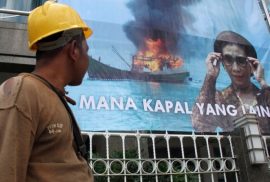
Questioning the Foreign Ship Sinking Policy

Academic EssayLaw & Human Rights Thursday, 24 March 2016

The news of sinking foreign ships that steal fishes in Indonesian territorial waters lately has become more widespread.  Almost all mass media preach about this government action.  This action is not new in Indonesia, it’s just that the news has just been noticed by the media, and it is considered unusual therefore it gets attention from the public.

In this era of globalization where relations between countries become something important, especially Indonesia’s relationship with countries in ASEAN the strict action of a country to foreigners will of course affect the good relations of both countries.  If we look through the case of the sinking of this foreign ships, then the Indonesian government’s actions that bombing the foreign ships without negotiate with its home country can be inferred to affect the good relations of both countries. read more

Indonesia and Emergency Child Marriage

Academic EssayLaw & Human Rights Monday, 21 March 2016

Think of yourself as a teenager, enthusiastic about the world. You have ambitious goals, which will help you achieve your dreams. You want to be a teacher, a lawyer, a doctor, or maybe an engineer. You see your body as a freshly bloomed flower, and enjoy immersing yourself in a romantic love story. However, life sometimes overturns all expectations. You are asked (or rather “forced”) to marry in order to improve the fate of the family. You are forced to marry in order to avoid sin. You are forced to marry by custom. You live your life as a mother, even though you’re still a child. You marry to obey your parents, and now you must obey a husband you do not recognize. Your dreams of becoming a lawyer, teacher, or doctor instantly waver. read more

“Win-Win Solution” in Overcoming Haze

Academic EssayPolitics and International Relations Tuesday, 8 March 2016

In the first and second week of September, the Standard Index of Air Pollution in Pekanbaru Riau stayed in the status of “very unhealthy” and “dangerous”. The Governor in act of Riau must announce the condition of Air Pollution Emergency. The post-decision of the status does not provide a significant meaning for the prevention of this smoke disaster. Until now, the thick haze still fluctuates in covering Pekanbaru and other cities in Sumatera Island and Kalimantan. Conversely, pressure on the Governor in act is stronger to evacuate 6.7 million citizens of Riau, even bringing back the desire for independence for a group of people who lost trust to the Central Government. Along with this haze calamity as well, the increasing demand for HTI and oil palm plantations getting higher, to be responsible, revoked its license and withdraw from Riau. Finally, only heavy rains which can calm down the anger of the people who become more flare up because of the haze. read more

School of Peace: Understanding ASEAN through Interfaith Dialogue

Academic EssayLaw & Human Rights Saturday, 20 February 2016

It has become a truth that the ASEAN community consists of various cultures, ethnicities and beliefs. Understanding the ASEAN community is clearly inseparable from the differences that exist. In this case, trust that grows and develops becomes part of the community inherent in their lives.

ASEAN became a gathering area and the development of a number of beliefs through trade channels and through colonization in the past. But basically, the ASEAN community itself has existed and has developed a number of beliefs since hundreds or thousands of years before, even its existence continues to be maintained as in indigenous peoples who have faith in nature. read more

Building ASEAN Identity

Academic EssayPolitics and International Relations Monday, 15 February 2016

ASEAN, Association of Southeast Asian Nations, is a geo-political and economic organization of countries located in Southeast Asia, which was formed on 8 August 1967, with signing the Bangkok Declaration by Indonesia, Malaysia, Philippines, Singapore and Thailand. As set out in the ASEAN Declaration, one of the aims and purpose of ASEAN is to accelerate the economic growth, social progress and cultural development in the region through joint endeavours in the spirit of equality and partnership in order to strengthen the foundation for a prosperous and peaceful community of Southeast Asian Nations. read more

Higher Education in Facing the ASEAN Economic Community

Academic EssayEducation Monday, 11 January 2016

The challenges of open competition because globalization is a challenge for all individuals and also the state in carrying out its functions as an institution that regulates the life of the nation and state in achieving prosperity. Globalization and connectivity make someone sneeze in the European hemisphere and cause flu for others in Asia. More specifically, the real challenge currently faced by ASEAN countries is open competition which is a consequence of the suppression of Asian Charter contracts by leaders of ASEAN countries on December 15, 2008. Cooperation agreements that resemble the union of European countries within the European Union making the movement of goods, people, and money become unhindered by territorial and political boundaries (borderless) this was then popularly known as the Asian Community which began to be effectively implemented in 2015. read more

Higher Education in Facing ASEAN Economic Community

Academic EssayEducation Monday, 11 January 2016

The challenge of open competition because of globalization become the challenge for all and also countries in running its function as an institution that regulate the life of nation and state in achieving prosperity. Globalization and connectivity make one’s sneeze in the European hemisphere cause flu for others in Asia. More specifically, the real challenge currently faced by ASEAN countries is the open competition which is the consequence of the suppression of Asian Charter contract by the leaders of ASEAN countries on December 15, 2008. The cooperation agreement that resembles the unity of European countries in the EU makes the movement of goods, people, and money become without obstruction of territorial and political boundaries (border-less) is then popularly known as the Asian Community which began effective implementation in 2015. read more

1…4567

Recent Posts

  • CESASS Chat #46: “Regime Types in Southeast Asia and the Interpretation of ASEAN Norms”
  • Fostering Academic Exchange with Center of Peatland and Disaster Studies, Universitas Riau (CPDS UNRI)
  • CESASS Chat #45: “A Nation Within a City: Contesting Space and Meaning in the Indonesian Capital” & “Perceptions of the Past and Present: What Does Borobudur Represent in the Wider Context of Discussions on Heritage?”
  • Supporting Institutional Efforts toward a Center of Excellence with Pusat Riset Sistem Peradilan Pidana Universitas Brawijaya (PERSADA UB)
  • Book Chapter: “Popular Culture in Cross-Cultural Understanding: Roles, Challenges, and Opportunities”
Universitas Gadjah Mada

Center for Southeast Asian Social Studies
Universitas Gajah Mada

Gedung PAU, Jl. Teknika Utara
Daerah Istimewa Yogyakarta 55281
pssat@ugm.ac.id
+62 274 589658

Instagram | Twitter | FB Page | Linkedin | Youtube

© Universitas Gadjah Mada

KEBIJAKAN PRIVASI/PRIVACY POLICY