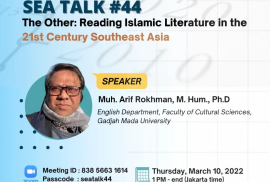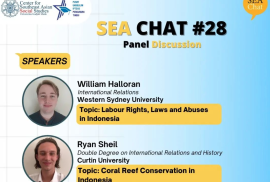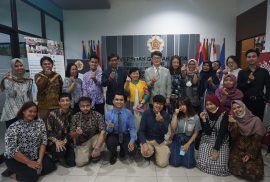
Education either functions as an instrument that is used to facilitate the integration of the younger generation into the logic of the present system and bring about conformity or it becomes the practice of freedom, how men and women deal critically and creatively with reality and discover how to participate in the transformation of their world. Said Prof. Alberto Gomes referencing Virilio’s ideas about critical pedagogy in South America, especially in the practice of Brazil education in SEA TALK Series #43, Prof. Alberto is a founding director of dialogue, emphatic, engagement, and peacebuilding at DEEP network and a professor at Emeritus La Trobe University in Melbourne Australia. In this SEA chat discussion, this time Prof. Alberto brings a discussion on the topic of emancipating the shackled mind and “the role of critical education”.
Activity
Dosen Fakultas Ilmu Sosial dan Ilmu Politik, Universitas Gadjah Mada, Prof. Dr. Phil Hermin Indah Wahyuni, M.Si., dikukuhkan sebagai Guru Besar dalam bidang Ilmu Komunikasi. Dalam pidato yang berlangsung pada Selasa (9/11) di Balai Senat Universitas Gadjah Mada, Yogyakarta, Prof. Hermin menyampaikan pidato yang berjudul Komunikasi Autopoiesis Sebagai Energi Adaptasi Sistem Sosial: Respon, Resonansi, (R)evolusi.
Dalam pidato pengukuhan, Prof. Hermin menyampaikan kompleksnya problem komunikasi dalam masyarakat modern. Menurut pandangan Prof. Hermin, komunikasi sebagai sebuah sistem yang komprehensif dan inti dari sistem sosial (masyarakat modern). Tradisi autopoiesis memiliki potensi sebagai jalan masa depan untuk memahami dan menjelaskan komunikasi dengan segala kompleksitas, baik sebagai ilmu maupun fenomena sosial. Sistem sosial (masyarakat modern) akan terhenti saat tidak ada komunikasi. Produksi dan reproduksi masyarakat ditentukan oleh komunikasi. Sehingga, sistem sosial merupakan sistem komunikasi itu sendiri.
Summer Course Program : (Re)constructing Southeast Asia
Southeast Asia is not a mere geographical space with a passive role in the international arena. The region instead has been becoming an active agent to engage in the international political discourse that covers the political, economic, social and cultural dynamics, as well as, security issues. The image of Southeast Asia as an actor that is capable of becoming an agent, is reflected in the political decision taken by the leaders of Southeast Asian countries to define and to present themselves as one single community, which is the ASEAN Community, and it has entered into force since 2016. Ironically, the level of interest and the number of studies conducted by academics regarding Southeast Asia are less developed inside the region.
As the global waste is expected to grow to 3.40 billion tonnes by the same year, the waste management system becomes the most concerning issue especially in Indonesia that is already struggling to deal with the current waste levels. The Center for Southeast Asian Studies (CESASS) of Gadjah Mada University (UGM) on Monday (06-09-2021) held SEA CHAT #27 with the topic of “Swimming in Plastic: An Examination into Indonesia’s Waste Management System”. The discussion was conducted by Mingming Alice Sun, 2nd year BA: Political Science and International Relations & Anthropology and Sociology from the University of Western Australia.
[CALL FOR PARTICIPANTS] SEA-MCA 2021 : Rediscovering Southeast Asia Amidst Its Multi-layered Burdens
Southeast Asia Conference on Media, Cinema, and Art
(SEA-MCA 2021): SEA-MCA 2021 : Rediscovering Southeast Asia Amidst Its Multi-layered Burdens
Description:
Southeast Asian studies have been matured in Western centres and have evolved considerably in the scholarly literature on international relations which continue seeing Southeast Asia as an un(differentiated) object of study. In response, even given the fact that no other region on the globe is more diverse than Southeast Asia, against external forces, Southeast Asian member countries have agreed to establish ASEAN — the Association of Southeast-East Asian Nations — community in 1967. Hence, it encounters rough roads in realizing a greater regional integration with its own considerable staggering problems and domestic fluctuations. To name a few, Asian Economic Community (AEC) is at its critical crossroads, ASEAN also has limited success due to its own non-interference norm and has its institutional nadir in political and security environment towards Myanmar coup and Thailand Junta shaping and slipping democracy into crisis.
National University of Singapore – Student Exchange Program (SEP) Application for AY2021/2022
[Self funded]
Greeting from the National University of Singapore!
NUS will once again be running Student Exchange Program (SEP) 2021/22 Semester 2.
We would like to invite you to apply for the programme!
About Student Exchange Programme (SEP) Application
The Student Exchange Programme (SEP) is the largest and most established global programme in NUS. Through the development and management on strategic and sustainable partnerships with universities globally. Under the scheme of Department Level Agreement between UGM CESASS and NUS Department of Southeast Asian Studies. UGM students both undergraduate and post-graduate with interest for Southeast Asian Studies are welcome to do exchange to NUS.
Sabtu (24/7/21), Pusat Studi Sosial Asia Tenggara (PSSAT) UGM kembali mengadakan webinar Digital Society. Webinar yang bertajuk “From Digital Toddler to Digital Retire #2”, merupakan rangkaian kedua dari diskusi yang dilaksanakan pada bulan lalu. Pada kesempatan kali ini, PSSAT menghadirkan Prof. Ir. Bambang Hari Wibisono dari Pusat Studi Perencanaan Pembangunan Regional (PSPPR) UGM dan Bapak Eka Indarto selaku Praktisi dan Konsultan Teknologi Informasi Komunikasi- RTIK Yogyakarta sebagai pembicara. Diskusi dengan dua topik berbeda akan dielaborasi oleh Bapak Sony Setyarso dari Founder and Director of 360 Solusi Teknologi selaku moderator diskusi.
Pada hari Sabtu (26/6/21), Pusat Studi Sosial Asia Tenggara (PSSAT) UGM kembali mengadakan webinar Digital Society. Adapun dalam kesempatan kali ini PSSAT UGM mengundang Dr. Ir. Arif Wismadi, M.Sc selaku Director the Growth Hub. Universitas Islam Indonesia dan I Dewa Gede Karma Wisana, Ph.D dari Demographic Institute, Universitas Indonesia. Meskipun masing-masing pembicara akan membawakan topik yang berbeda, namun fokus webinar kali ini berjudul “From Digital Toddler to Digital Retire #1”. Selanjutnya, diskusi ini dimoderatori oleh Prof. Aris Ananta, Ph.D dari Universitas Indonesia.
Pusat Studi Sosial Asia Tenggara (PSSAT) UGM kembali mengadakan webinar “Digital Society” yang pada kesempatan kali ini merupakan discussion series yang ketujuh. Diskusi ini membahas tentang “Islam Nusantara di Era Disruptif”, sehingga PSSAT UGM menghadirkan K.H. Yahya Cholil Staquf, selaku Indonesian Islamic Scholar dan Katib AAM PBNU yang mempunyai pengalaman dan kapasitas untuk menjelaskan topik tersebut. Selanjutnya, diskusi ini dimoderatori oleh Prof. Dr. Sunyoto Usman dari Departemen Sosiologi UGM sekaligus selaku inisiator dari komunitas “Digital Society”.
Senin (3/5) Pusat Studi Sosial Asia Tenggara (PSSAT) bersama dengan Digital Society kembali mengadakan Discussion Series #6 bertajuk “Informalitas Teknologi: Belajar dari Pengalaman Penetrasi Bisnis Transportasi Berbasis Aplikasi di Kota Malang”. Diskusi menghadirkan Dr. phil. Anton Novenanto dari Departemen Sosiologi, Universitas Brawijaya. Diskusi dimoderatori oleh Pradipa P. Rasidi dari University of Amsterdam. Digital Society Discussion Series kali ini mengupas tentang formalisasi jenis transportasi konvensional maupun berbasis aplikasi di Kota Malang.