• Tentang UGM
  • IT Center
  • English
    • Bahasa Indonesia
    • English
Universitas Gadjah Mada Center for Southeast Asian Social Studies
Universitas Gajah Mada
  • Home
  • About Us
    • Overview
    • Researcher
    • Partner Researcher
    • Partner Institution
    • Library
  • Research
  • Program
    • International Conference
    • SUMMER COURSE
    • CESASS Research Fellowship
    • INTERNSHIP
    • CESASS TALK
    • CESASS Chat
    • CESASS Vodcast
    • SEA Movie
    • Workshop
  • Publication
    • Journal
    • Book
    • Proceeding
    • Policy Brief
  • Academic Essay
    • Culture & Linguistics
    • Digital Society
    • Economic and Social Welfare
    • Education
    • Media & Communication Studies
    • Law & Human Rights
    • Politics and International Relations
    • Article Guidelines
  • Home
  • Activity
  • SEA Talk_eng
  • page. 4
Arsip:

SEA Talk_eng

[SEA Talk # 9] Opening the Window of Southeast Asia Cinema

ActivitySEA Talk_eng Monday, 10 October 2016

It is undeniable that Southeast Asian films have their own position and have gained the spotlight of the world through various forms of appreciation. Films like “Kinatay” by Briliante Mendoza from the Philippines won the best director category at the Cannes Film Festival in 2009. In 2010, there was a movie titled “Uncle Boonmee” from Thailand made by director Apichatpong Weerasethakul who won the Palme d’Or in the same event . Last year 2016, the same award was awarded to Indonesian filmmakers. The work of Wregas Bhanuteja titled “Prenjak” became the best film on this prestigious film festival . The above facts serve as evidence of Southeast Asian cinema’s success in taking a position on the world cinema map. read more

[SEA Talk # 8] Seeking a Meeting Point for Religious Freedom and Public Policy: A Lesson from Southeast Asia

ActivitySEA Talk_eng Saturday, 25 June 2016

One of the consequences of the diversity that exists in Southeast Asia is the emergence of many dynamic questions that never expires to be discussed. One of the questions we keep thinking about is, how does this region survive with hundreds of local beliefs and at the same time impose public policy on religious rules? Dr. Dicky Sofjan discussed the answer to this question in SEA Talks # 8, on Thursday afternoon,  (16/06/16). In his presentation, Dr. Dicky explained that the religious logic in society is often different from public policy. This can not be separated from the influence of the democratic system adopted by almost all countries in Southeast Asia. According to him, the application of democracy leads to unintended consequences, such as the phenomenon of misuse of the law, decentralization that causes inequality, as well as multi-interpretation of the beliefs of one group. On the other hand, the state also has great authority through the prevailing system. Just as Malaysia that applies Islam as a national religion and lists it in the constitution. This rule then legitimizes the expulsion of Ahmadiyah pilgrims in one of the mosques in Malaysia and also the rules that lead to minority discrimination. read more

[SEA Talk # 6] “New Style” of (Total) History Reading of Southeast Asia ala Anthony Reid

ActivitySEA Talk_eng Friday, 8 April 2016

When reading the literature on the history of Southeast Asia, we often take to the depiction of a character who has a position or power in a community context. The depiction of Southeast Asian history is then often associated (intentionally or unintentionally) strictly with economic or political aspects. This makes reading in the literature of Southeast Asian history often plastered with emphasis on facts, dates, names or personalities.

However, we will encounter different things when reading A History of Southeast Asia: Critical Crossroads. This is one of a professor’s works from Australian National University, Anthony Reid. This book at least provides a new offer to the study of the history of Southeast Asia. In this book, the reading of the history of Southeast Asia places more emphasis on the aspects of its context, processes, and historical intersections. read more
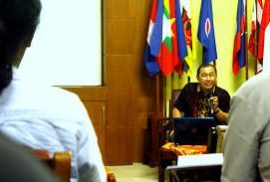
[SEA Talk # 5] The fate of Southeast Asian Studies Scientifically and Institutionally

ActivitySEA Talk_eng Friday, 1 April 2016

“Area studies programs were closed or merged into other units; on the eve of the September 11 attacks, half of the top political science departments in the United States did not have a Middle East studies program. ”

—

The above sentence was written by Francis Fukuyama quoted by Budiawan as the opening of the SEA-Talks # 5 on Tuesday afternoon (29/01/2016) in Center for Southeast Asian Social Studies  (CESASS). It is a writing describing the recent fate of institutionalized regional studies in the United States. The view of the Crisis on the study of the area by Francis Fukuyama was also supported by the writings of Professor Robert Elson which stated that, 10 years ago, Asian Studies in Australia had a strong activity. But conditions have now declined, and it is believed that only Australia National University remains in this crisis. read more

[SEA Talk] Recognizing Familiarity and Exchange in Southeast Asian Communities and around: Reading the History of the Austronesian Race

ActivitySEA Talk_eng Tuesday, 23 February 2016

People in Southeast Asia and surrounding areas are believed to have the same root or from the same source. It is characterized by several cultures, customs, and values that are still reflected in the life of people in Southeast Asia and beyond. This thesis was presented by Ronnie Hatley Ph.D in his presentation at SEA Talk discussion of Center for Southeast Asian Social Studies in collaboration with American Institute For Indonesian Studies. This discussion was held on Thursday, February 18, 2016, followed by dozens of academics and researchers from various scientific backgrounds. read more

[SEA Talk # 1] Mass Media and Construction of ASEAN Community

ActivitySEA Talk_eng Wednesday, 30 December 2015

The first PSSAT’s SEA Talk program on May 29, 2015 was titled “Mass Media and ASEAN Community Construction”. Dr. Phil. Hermin Indah Wahyuni, M.Si, head of PSSAT, became the speaker that afternoon. According to her, the mass media now is not fully concerned about the importance of the ASEAN Economic Community (MEA). Mass media, in this case journalists, need to be more in knowing this issue so that it is not only becoming a discourse on the level of the elite alone but this information can be up to the community in Southeast Asia itself. read more

1234

Recent Posts

  • CESASS Chat #47: “Artivism in Indonesia” & “Maritime Dispute in South China Sea”
  • CESASS Chat #46: “Regime Types in Southeast Asia and the Interpretation of ASEAN Norms”
  • Fostering Academic Exchange with Center of Peatland and Disaster Studies, Universitas Riau (CPDS UNRI)
  • CESASS Chat #45: “A Nation Within a City: Contesting Space and Meaning in the Indonesian Capital” & “Perceptions of the Past and Present: What Does Borobudur Represent in the Wider Context of Discussions on Heritage?”
  • Supporting Institutional Efforts toward a Center of Excellence with Pusat Riset Sistem Peradilan Pidana Universitas Brawijaya (PERSADA UB)
Universitas Gadjah Mada

Center for Southeast Asian Social Studies
Universitas Gajah Mada

Gedung PAU, Jl. Teknika Utara
Daerah Istimewa Yogyakarta 55281
pssat@ugm.ac.id
+62 274 589658

Instagram | Twitter | FB Page | Linkedin | Youtube

© Universitas Gadjah Mada

KEBIJAKAN PRIVASI/PRIVACY POLICY