

Yogyakarta, September 22, 2026 — Center for Southeast Asian Social Studies at Universitas Gadjah Mada (CESASS UGM) hosted its regular CESASS Talk #57, titled “Indonesia-Iran Cultural and Intellectual Relations: Historical Foundations, Contemporary Challenges, and Future Horizons”. Held in a hybrid format at the Indonesia Room, CESASS UGM, and via Zoom, the session featured Dr. Yahya Jahangiri, Cultural Counsellor of the Embassy of the Islamic Republic of Iran, as the guest speaker. The session was moderated by Dicky Sofjan, M.A., MPP., Ph.D., from the UGM Graduate School.
In the opening declaration, CESASS representative Dr. phil. Vissia Ita Yulianto emphasized that dialogue and mutual understanding are vital in an interconnected world to bridge differences and foster peace. She noted that the consequences of regional geopolitics extend far beyond borders to impact the global geopolitical landscape, international relations, businesses, economic sectors, academic institutions, governments, communities, and the everyday experiences of people worldwide. Within this fragile global landscape, academic institutions bear a vital responsibility to move beyond headlines by encouraging scholars and students to engage in rigorous inquiry and examine diverse perspectives. As such, meaningful avenues for mutual learning between Indonesia and Iran must be opened, allowing for history and culture to be understood through an intellectual and human lens.
Opening the thematic presentation, Dr. Yahya Jahangiri highlighted that relations between Iran and the Indonesian archipelago long predate modern diplomatic ties. Framed around the concept of the Indian Ocean as a civilisational corridor, he explained how commerce between the Persian Gulf, India, Aceh, and the wider Malay world carried books, vocabulary, and scholars. Describing language as a small archive containing fossilised evidence of historical contact, Dr. Jahangiri pointed to Persian loanwords in Indonesian, such as syah, dewan, anggur, and bandar, to illustrate how language retains cultural memories. Furthermore, he noted that manuscripts acted as early ambassadors, citing classical texts like Hikayat Amir Hamzah, Hikayat Muhammad Hanafiyyah, and the Acehnese political treatise Tāj al-Salāţīn, which drew upon Persianate andarz counsel to shape Indonesian concepts of justice and good governance.
Addressing contemporary media portrayals, Dr. Jahangiri urged audiences to distinguish between media headlines and the broader Persianate cultural sphere. He emphasised that Iran should not be reduced to the views of news editorials that refer exclusively to a Shia identity, reminding participants that major classical Sunni scholars and Arabic grammarians were of Persian origin. Dr. Jahangiri stressed the importance of localised Islam, explaining that Islam enriches local traditions, and advocating that Shia practice in Indonesia should naturally reflect Indonesian cultural expressions rather than Iranian norms. As an example of local adaptation, he highlighted how Muharram memory was integrated into West Sumatran and Bengkulu heritage through the Tabuik and Tabot traditions.
Examining contemporary connectivity, he presented working figures showing that approximately 300 Indonesian students currently study in Iran, around 500 Indonesians reside in Iran, and between 10,000 and 15,000 annual cross-visits occur between the two nations. He outlined expanding institutional cooperation established around 2023, including inter-university MoUs, visiting lectureships, joint research, and cultural co-productions in cinema, literature, and media. Among future collaborative horizons, he highlighted a joint film project combining the spiritual philosophy of Imam al-Ghazali with the Indonesian legacy of the Wali Songo to translate intellectual history into accessible public culture.
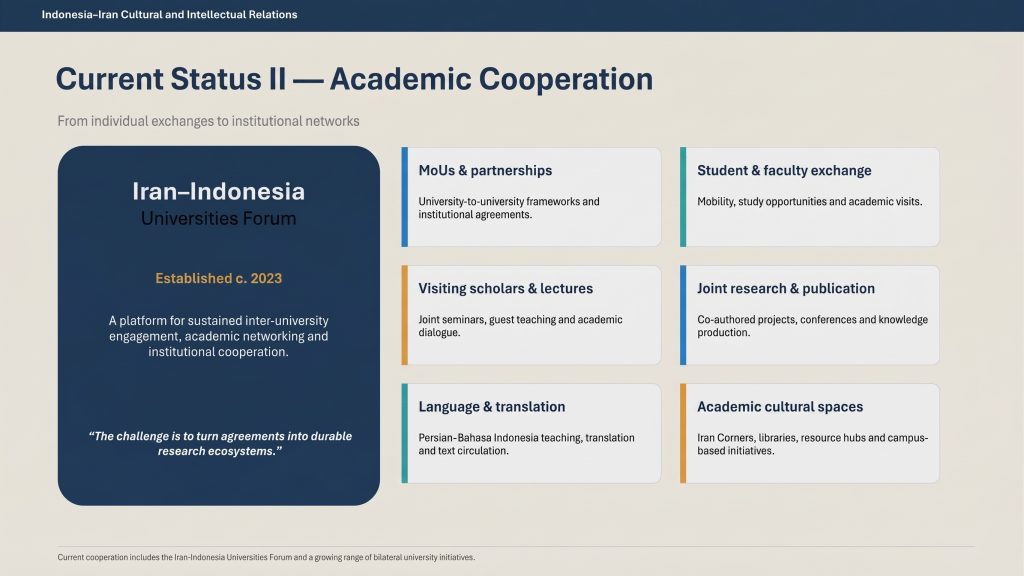
The presentation prompted an interactive discussion moderated by Dr. Dicky Sofjan. Responding to inquiries about Indonesia’s non-aligned foreign policy amid Middle Eastern tensions, Dr. Jahangiri cited shared solidarity with Iran across the Indonesian public. Addressing queries about academic collaboration in STEM, Dr. Jahangiri noted that nearly half of Indonesian students in Iran are currently enrolled in medical and technological fields. In response to questions from international scholars, including Prof. Mark Woodward of Arizona State University, the discussion turned to manuscript conservation partnerships and strategies for broadening inter-university academic dialogue to reach middle- and working-class communities in both societies.
Concluding the session, Dr. Dicky Sofjan highlighted the importance of intentionality in academic collaboration, noting Iran’s high standing in global scientific indexing and the deep rational and philosophical traditions that continue to characterise Persianate scholarship. Talk #57 concluded with a shared recognition that sustainable cultural diplomacy requires a full, multi-dimensional vision of each society, rooted in historical understanding, academic exchange, and joint cultural creation. In particular, CESASS notes the vital role of universities in intellectual exchange. It thanks Dr. Jahangiri for his insights on the matter and welcomes future opportunities for intellectual collaboration between UGM and Iranian universities across faculties in STEM, social-humanities, and South-East Asian studies.
For further information regarding upcoming academic programs, publications, and events, please contact the Center for Southeast Asian Social Studies at Universitas Gadjah Mada via email at pssat@ugm.ac.id, visit the official website at pssat.ugm.ac.id, or follow @pssatugm across social media platforms.


Reporter: Benji Light