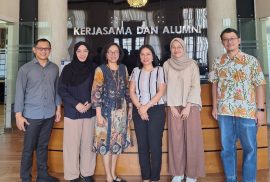
Yogyakarta, February 27 & March 9, 2026 — Multidisciplinary dialogue is more important today because the challenges we face are indeed complex, interconnected, and global in scope. Issues such as climate change, artificial intelligence, public health, socio-cultural and environmental justice, Asean youth and (un)employment, and economic inequality cannot be solved solo by one field alone. For instance, climate solutions require collaboration between environmental scientists, engineers, economists, and policymakers, while advances from companies like OpenAI raise not only technical questions but also ethical, legal, and social concerns. As technology evolves faster than regulation and cultural adaptation, open dialogue across disciplines ensures innovation remains responsible, balanced, and aligned with human values.
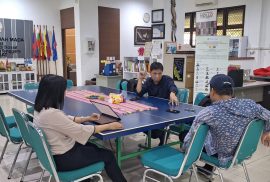
Yogyakarta, February 27, 2026 — Eastern Indonesia is home to some of the most pristine marine and terrestrial ecosystems in the world, including coral reefs, mangrove forests, and endemic wildlife. Many of these eco-islands remain largely off the mainstream tourism map, offering unique opportunities for sustainable tourism that can support both environmental conservation and local communities. Promoting responsible travel can showcase the region’s natural wonders while preserving them for future generations, emphasizing the need for careful planning and sustainable infrastructure development.
Yogyakarta, Febuary 26, 2026 — There is growing public concern that poor waste management may contribute to the spread of disease—an issue that remains as urgent today as ever.
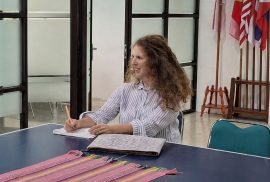
This topic was raised by Dr. Viola Schreer, a German anthropologist, during her recent visit to CESASS. Dr. Schreer, who currently works as postdoc researcher at the Institute of Social Anthropologist at the Austrian Academy of Sciences, has long-standing research experience in on human-environmental relations in Indonesia, particularly Central Kalimantan. She has been working in the region for since 2009, and is keen to further explore waste management challenges in Indonesia. Notably, Dr. Schreer speaks fluent Bahasa Indonesia and Ngaju Dayak, the lingua franca of Central Kalimantan, enabling her to engage directly and meaningfully with local communities.
East Kalimantan, Febuary 8–14, 2026 — Center for Southeast Asian Social Studies at Universitas Gadjah Mada (CESASS UGM) research team conducted fieldwork in East Kalimantan to examine socio-cultural transformation and environmental justice in the context of Indonesia’s capital relocation project, Ibu Kota Nusantara (IKN).
Recognizing that the implications of the new capital extend beyond its administrative boundaries, the team has expanded the locus of research to encompass East Kalimantan more broadly. This approach enables a deeper understanding of interconnected processes affecting communities, ecosystems, and governance structures across the province.
Yogyakarta, Febuary 3, 2026 — Across Indonesia’s cities, rooftops stretch quietly under the tropical sun. Often unnoticed, rooftops hold more than shelter, representing untapped economic and environmental value.
These pressing issues framed the discussion at the latest CESASS Chat forum hosted by the Center for Southeast Asian Social Studies at Universitas Gadjah Mada (CESASS UGM), under the theme “GeoSpectra: AI-Based Geospatial Modelling for Rooftop Photovoltaic Assessment and Property Tax Valuation in Indonesia.”
Yogyakarta, January 28, 2026 — Center for Southeast Asian Social Studies at Universitas Gadjah Mada (CESASS UGM) organized a multidisciplinary discussion involving scholars from the Faculty of Engineering and the Faculty of Social and Political Sciences, reaffirming the importance of cross-disciplinary collaboration in responding to contemporary social and technological challenges.
The discussion highlighted the growing interconnection between technology and society, emphasizing that technological innovation both shapes and is shaped by social, political, and cultural contexts. Addressing complex regional and global issues therefore requires collaborative approaches that integrate technical expertise with social and political analysis.
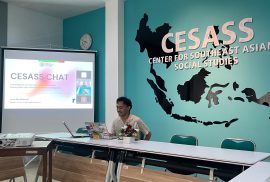
On September 12, 2025, Center for Southeast Asian Social Studies at Universitas Gadjah Mada (CESASS UGM) successfully hosted the CESASS-CHAT #3 in a hybrid format, held at the Indonesia Room, CESASS UGM. The session featured Jauza Rifa Abdurrafi, a student of Politics and International Relations at the University of Nottingham. Delivering a presentation titled “Talent Migration and Economic Growth in Indonesia: Balancing Brain Drain, Brain Gain, and Institutional Capacity,” Jauza shed light on the realities of Indonesian migration and its significance for the nation’s future development.
Yogyakarta, August 21, 2025 — Center for Southeast Asian Social Studies at Universitas Gadjah Mada (CESASS UGM) took part in the Acicis NGO Fair 2025 at the front area of the Margono Building (Greenland), Faculty of Cultural Sciences, UGM. Organized by the Australian Consortium for In-Country Indonesian Studies (Acicis) and supported by the Australian Government, the annual fair brought together leading organizations across Yogyakarta to introduce internship and volunteer opportunities to local and international students.
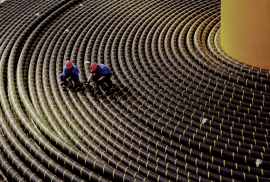
Information has become a crucial asset in a globalised world order, speed and consistent transmission of information have become vital for a thriving digital economy. To facilitate this global flow of information, subsea communication cables connect every continent in a vast network. Current estimates suggest subsea cables transmit more than 95% of internet traffic, facilitating USD $10 trillion in financial transactions every day in the US financial sector alone (Brock, 2023; Goodman & Wayland, 2022). Additional research has stressed an increased cable manufacturing effort by several nation states, coupled with tense bidding for cable project contracts and the designation of placements, which disrupt the interests of other parties (Noor, 2024, p. 7-8). Arguably, this tense situation opens a new dimension to the ongoing security dilemma between regional superpowers in Southeast Asia, with uncertain and perhaps harmful outcomes. The fragility of these cables with their vital communication and electricity transmission capacity, will leave them as exposed desirable targets in conflict scenarios. I will additionally analyse two factors to consider from a global competition context: market driven interests and state driven interests.
Nusantara, August 11–16, 2025 — A field survey was conducted in IKN (Nusantara Capital City) for the 2025 Fundamental Research scheme under the topic: “Smart Innovation and Waste Management Systems to Support the Implementation of a Smart City in Indonesia’s New Capital.”
The 2025 Fundamental Research Team is led by Prof. Dr. Rini Rachmawati, S.Si., M.T. (Head of the Regional Development Program, Master of Geography UGM, and Director of the Center for Southeast Asian Social Studies UGM), with research members Prof. Dr. Eko Haryono, M.Si. (Lecturer at the Department of Environmental Geography and Head of the Doctoral Program in Environmental Science) and Ir. Agus Prasetya, M.Eng.Sc., Ph.D. (Lecturer at the Department of Chemical Engineering).