• Tentang UGM
  • IT Center
  • English
    • Bahasa Indonesia
    • English
Universitas Gadjah Mada Center for Southeast Asian Social Studies
Universitas Gajah Mada
  • Home
  • About Us
    • Overview
    • Researcher
    • Partner Researcher
    • Partner Institution
    • Library
  • Research
  • Program
    • International Conference
    • SUMMER COURSE
    • CESASS Research Fellowship
    • INTERNSHIP
    • CESASS TALK
    • CESASS Chat
    • CESASS Vodcast
    • SEA Movie
    • Workshop
  • Publication
    • Journal
    • Book
    • Proceeding
    • Policy Brief
  • Academic Essay
    • Culture & Linguistics
    • Digital Society
    • Economic and Social Welfare
    • Education
    • Media & Communication Studies
    • Law & Human Rights
    • Politics and International Relations
    • Article Guidelines
  • Home
  • Activity
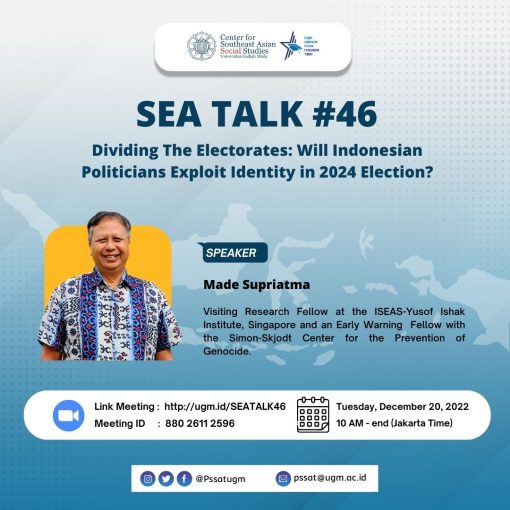
  • SEA Talk #46: Dividing The Electorates: Will Indonesian Politicians Exploit Identity in 2024 Election by Made Supriatma

SEA Talk #46: Dividing The Electorates: Will Indonesian Politicians Exploit Identity in 2024 Election by Made Supriatma

  • Activity, SEA Talk_eng
  • 23 December 2022, 15.00
  • Oleh: pssat
  • 0

On December, 20th 2022, at 10.00 (GMT +7) Center of Southeast Asian Social Studies (CESASS) Universitas Gadjah Mada held an online seminar, the 46th South East Asia Talk (SEA Talk). This seminar was inviting Made Supriatma, one of the visiting fellows at ISEAS – Yusof Ishak Institute, Singapore, whose presentation titled “Dividing The Electorates: Will Indonesian Politicians Exploit Identity in 2024 Election”.

This seminar discussed the role of identity that is embedded in each individual and its potential to trigger and to influence the individual as voters during the general election. Indonesia’s social-cultural landscape, which is diverse, isn’t exceptional from the identity narratives during election campaigns. 

Historically it can be traced back to when the 1st general election was held in 1955 where the voters tended to give their vote for their relevant legislative candidate from certain political parties. During the New Order era, there is an attempt by the government to create a more homogeneous society so that identity polarization isn’t something keen. A diversity society started to burst again after the reformation attempt in 1998 then affecting the “minority-majority” phenomenon. After that, a group based on religion and/ tribes became prevalent in Indonesia, moreover during national-level elections. 

The exploitation of identity during the upcoming 2024 election in Indonesia is likely to be repeated because it’s one of the easiest ways to create a majority. 

Written by: Mohammad Izam Dwi Sukma

Leave A Comment Cancel reply

Your email address will not be published. Required fields are marked *

*

Recent Posts

  • Strengthening Regional Studies Through Convergent Scholarship
  • Exploring the Social Dimensions of Waste: Insights from Dr. Viola Schreer
  • CESASS Team Conducts Field Research on Socio-Cultural Transformation and Environmental Justice in East Kalimantan
  • CESASS Chat #48 “GeoSpectra” by AInsightGeo Team
  • Bridging Academic Silos Through Collaborative Dialogue
Universitas Gadjah Mada

Center for Southeast Asian Social Studies
Universitas Gajah Mada

Gedung PAU, Jl. Teknika Utara
Daerah Istimewa Yogyakarta 55281
pssat@ugm.ac.id
+62 274 589658

Instagram | Twitter | FB Page | Linkedin | Youtube

© Universitas Gadjah Mada

KEBIJAKAN PRIVASI/PRIVACY POLICY