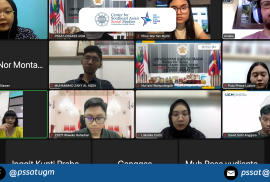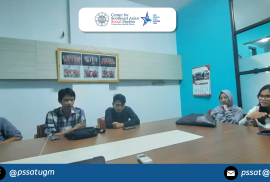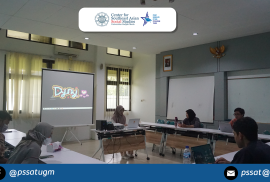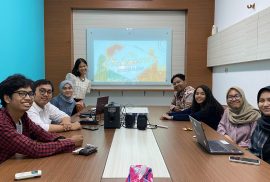
On Wednesday, March 20, 2024, Sabrina Joy S. Tan, a postgraduate student at Universitas Gadjah Mada and an intern at CESASS UGM from the Philippines, led a sharing session to introduce her country to fellow interns. Sabrina began her presentation with an intriguing fact that might surprise those unfamiliar with the Philippines: the country consists of 82 provinces, more than Indonesia. Additionally, she highlighted a unique feature of the Philippine flag: during times of war, the red stripe is displayed on top, whereas during peace, the blue stripe is on top.

internship
Introduction
Film, as a source of entertainment and escapism, has played a crucial role throughout history. It serves beyond mere enjoyment, aiding in reconciling with the past, preserving traditions, and expressing national identity. During the twentieth century, the introduction of film in Southeast Asia varied across countries, primarily through colonial contact driven by various European powers, which significantly impacted the film industry. It has brought the introduction of technology to Southeast Asia, which marked the inception of a local film industry. Films began to incorporate local languages, music, settings, and actors, gradually gaining popularity among the local audience (Ang, 2021). Despite initial developments, certain countries experienced downfall periods that erased progress. Cambodia, notably affected by the painful political history of the Khmer Rouge invasion, faced considerable challenges, including the film business.
Dr. phil. Vissia Ita Yulianto (Head of Program and Publication of CESASS UGM) taught an academic writing workshop as part of the internship activities from October to December 2023.
The first lesson was held in the second week of November and focused on how to write academic articles using scientific principles such as reliable publications and valid sources.
The second class, held in the third week of November, covered qualitative research methods, with an emphasis on methodology and data collection.
Southeast Asia is a region developing and expanding fast in terms of population, importance, and interconnectedness. While the future beckons promisingly for the continued success of the region, potential backsliding into instability threatens to change this trajectory. Non-traditional aspects of security now take the forefront of issues threatening this backsliding. While changes in the balance of power between Southeast Asian nations or the efficacy of institutions remain integral to the region’s future, threats like a warming and unpredictable climate or breaches in cyber-security now have the potential to drastically change the state of security in the region.
The Universal Declaration of Human Rights (UDHR) adopted in 1948 by the international community,proved that human rights were being accepted as universal norms that needed to be respected, protected, and promoted. The phrase in the UDHR “All human beings are born free and equal in dignity and rights” means that everyone is equal in claiming their rights without distinction. This is supported by the first paragraph of the Vienna Declaration and Programme of Actions preambular, where it recognizes human rights as a universal norm by stating that “All human rights are universal, indivisible and interdependent and interrelated.” UDHR as a foundation of international treaties later became the foundation of other international human rights instruments including Convention on the Elimination of All Forms of Discrimination against Women (CEDAW). The existence of CEDAW in international law marks the importance of protection and promotion of women’s rights and gender equality between men and women, but in the process of gender equality to some women it is more challenging especially to women from minority communities, like indigenous women. Report from the United Nation (UN) special rapporteur on violence against women by Reem Alsalem stated that indigenous women and girls experienced systematic discrimination in indigenous and non-indigenous justice system (United Nations Human Rights Office of the High Commissioner, 2022). Furthermore, the Human Rights Committee in their General Comment No. 28, art. 3 highlight that the inequality of the enjoyment of rights by women is deeply embedded in tradition, history and culture including religious attitudes.
On Tuesday (28/03/2023), an international relation student Gadjah Mada University, named Shynna Nor M. Siawan presented her advocacy project entitled “Provision to ban FGM (Sunat Perempuan) in Indonesia to Global Arena”. The sharing session is part of intern’s activity in Center for Southeast Asian Social Studies Gadjah Mada University. She shared this topic because she want to spread awareness that FGM has become big issue in the world.
At the beginning of her presentation, Shynna said that Female Genital Mutilation (FGM) or Sunat Perempuan is an ancient tradition of removing the female external genitalia (performed on children) with no medical prescription. Commonly, it is happened in islamic countries such as Indonesia, Brunei, Malaysia, Philippines, Africa, ect. They do FGM for some reason like purity, cleanness, and control sexual desire for woman. Unfortunately, This practice has been passed down from generation to generation. Many young women end up practicing FGM because they have been indoctrinated that it is the right thing to do.
On March 21/2023, a weekly sharing session via zoom was conducted by Mr.Aniello Iannone who comes from Italy. He presented and lead the sharing session with his Master’s Degree thesis topic, “Responding to Anti-human trafficking: The Role and Challenges of NGOs in Indonesia”. He is been a lecturer at the Faculty of Social and Political Science in Universitas Diponegoro (Undip) Semarang and a researcher who explores various topics focusing on democracy, politics, political economy, and international relations in Indonesia and Southeast Asia regions. His thesis was intended to find out the challenges faced by NGOs that are working on Human Trafficking issues, the law enforcement towards anti-human trafficking in Indonesia, and the motives of people who got trafficked. He used qualitative research analysis, specifically the interview method, and 3-5 NGOs in Indonesia had been interviewed.
On 15 March 2023, CESASS student interns conducted a weekly sharing session at the PAU Building. Putu Prisca Lusiani, a postgraduate student from the International Relations Department at Fisipol UGM, volunteered as the speaker for this week’s session, titled “Indonesia’s Chairmanship in ASEAN 2023: What to Expect?” She considered the topic relevant because Indonesia is the largest member country of ASEAN. Thus, other member countries expect Indonesia to be able to solve several problems that have happened over the decades, including the political instability in Myanmar.
Last Friday (3/3), a weekly agenda known as the “sharing session” was held for CESASS internship students. The speaker for the week was Wiweko Rahadian Abyapta, an undergraduate student from the Faculty of Law at Universitas Gadjah Mada, who is also an intern from the first batch of this year. Wiweko presented a topic titled “Sustainable Agriculture in the Philippines” from a policy-making perspective. He shared this topic because he won Best Policy Paper at the Young ASEAN Leaders Policy Initiative 2023.
On Monday (6/3/2023), an intern named Dyny Wahyu Seputri, who is pursuing a Master’s degree in American Studies at Gadjah Mada University, presented her thesis research entitled “Towards a Transnational View: Pencak Silat in the United States of America” in a forum at the PSSAT office. The forum was the 39th Seachat, which is one of the internal activities at PSSAT. The speaker presented her ideas on the direction of the development of Pencak Silat martial arts in the United States.