

Photo: Chalinee Thirasupa / Reuters (February 2, 2023)
Abstract
Southeast Asia faces a serious air pollution crisis due to rapid urbanization, industrial growth, and unsustainable farming practices. The proposed Clean Air Act in Thailand represents a crucial step in tackling this pressing issue and reflects broader debates on the effectiveness of legislative interventions. This article examines the provisions and potential impacts of Thailand’s Clean Air Act. While the Act introduces promising measures such as recognizing the right to clean air and establishing committees for air quality management, concerns persist regarding enforcement mechanisms, socioeconomic implications, and the perpetuation of car dependency. By contextualizing the Act within the broader context of systemic challenges and competing priorities, this article emphasizes the necessity of comprehensive and holistic approaches to air pollution management. Collaborative efforts across governance levels, embracing sustainable practices, technological innovation, and fostering public participation are essential for effectively addressing air pollution not only in Thailand but also across Southeast Asia.
Keywords: Clean Air Act, Thailand, Air pollution, Southeast Asia, Systemic issues
Introduction
Southeast Asia is grappling with an alarming air pollution crisis due to rapid urbanization, industrialization, and unsustainable agricultural practices (Vadrevu, Ohara, & Justice, 2017). The region faces widespread health impacts and economic losses stemming from Indonesia’s forest fire haze, agricultural burning in Cambodia, Laos, and Myanmar, and urban smog in Malaysia, Thailand, and Vietnam (Taghizadeh-Hesary, 2020). According to the International Institute of Applied Systems Analysis, failure to address air pollution by 2030 could result in 216,000 premature deaths and costs of US$43.2 billion in Indonesia, 24,000 premature deaths and costs of US$18.3 billion in Thailand, and 5,000 premature deaths and costs of US$1.2 billion in Cambodia (Klimont & Slater, 2023). World Bank data reinforces the urgency, showing that in 2019, health damages from PM2.5 exposure accounted for 6.6% of GDP in Indonesia, 6% in Thailand, and 6.5% in Vietnam (World Bank, 2022).
Failure to address air pollution in Southeast Asia not only jeopardizes public health but also violates fundamental human rights, including the right to a clean and healthy environment. Prolonged exposure to polluted air further threatens critical Sustainable Development Goals (SDGs), particularly Goal 3 (Good Health and Well-Being), Goal 7 (Affordable and Clean Energy), Goal 11 (Sustainable Cities and Communities), Goal 12 (Responsible Consumption and Production), and Goal 13 (Climate Action).
Thailand has been thrust into the spotlight since Prime Minister Srettha Thavisin took office in 2023, pledging to tackle the country’s notoriously poor air quality through comprehensive policies, as exemplified by the Clean Air Act. This pledge followed a court ruling that held the previous government responsible for inaction when Chiang Mai experienced severe PM2.5 levels as high as 165 µg/m³ (Nation Thailand, 2024b; 2024c). While seven versions of the Clean Air Act were initially approved by the House, only two remain under consideration after the Prime Minister’s review, due to conflicts with the Financial Act (Enviliance Asia, 2024). Both versions, however, share the same overarching goal of improving air quality and reducing pollution (Enviliance Asia, 2024). Could this finally be a breath of fresh air for Thailand’s long-standing advocacy against air pollution?
The current scholarly debate highlights the critical need for comprehensive legislation and effective environmental policies to tackle air pollution (Quarmby, Santos, & Mathias, 2019; Jafaru, Charkloo, & Pasalari, 2021), while acknowledging that legislation alone may not resolve all issues (Marks & Miller, 2022; Marks & Lulitanonda, 2023). This article, therefore, examines the draft of Thailand’s Clean Air Act, exploring both its potential and its limitations. While the Act represents a significant step forward, systemic issues may not be fully mitigated, and Thailand could still encounter substantial challenges. By emphasizing these concerns, the article underscores the urgent need for coordinated action across multiple levels of governance to address the root causes of air pollution. Ultimately, it aims to contribute to ongoing policy discussions and advocacy efforts to promote public well-being in Southeast Asia.
Literature Review
Previous studies have pointed out the serious air pollution problem in Southeast Asia, particularly in countries like Indonesia, Thailand, and Vietnam (Vadrevu, Ohara, & Justice, 2017; Klimont & Slater, 2023). Academic discussions identify two perspectives on effective environmental policies for addressing air pollution in the region. One advocate emphasizes comprehensive legislation with robust enforcement, multi-stakeholder collaboration, and decentralization (Quarmby, Santos, & Mathias, 2019; Jafaru, Charkloo, & Pasalari, 2021), while the other perspective stresses that legislation alone may not resolve all issues (Marks & Miller, 2022). This perspective suggests the importance of addressing broader systemic issues such as conflicts with economic priorities and accountability challenges (Marks & Miller, 2022; Marks & Lulitanonda, 2023). This is supported by the limited success of initiatives like the Philippine Clean Air Act enacted in 1999 in mitigating emissions (Enano & Subingsubing, 2019). This article aims to contribute novelty to academic discussions regarding policies to tackle air pollution issues by assessing the potential impact of the Clean Air Act in Thailand while also highlighting potential shortcomings due to systemic issues and competing government priorities.
Methods
This article draws upon a combination of qualitative research methods, including literature review and policy analysis. By triangulating multiple sources of information from secondary sources such as scholarly articles, reports, and official documents, it aims to provide a comprehensive and nuanced overview of Thailand’s current air pollution policies along with their implications and shortcomings.
Results
This section aims to address the research question raised in the introduction by examining the effectiveness of Thailand’s Clean Air Act in addressing air pollution challenges. It will be subdivided into two subsections. Firstly, it outlines the key provisions of the Clean Air Act and discusses their possible implications for air pollution management in Thailand. Secondly, it highlights several shortcomings possibly stemming from prevailing systemic issues and competing government agendas.
Key Provisions of the Clean Air Act and Its Potential Impact
The Clean Air Act, currently under discussion, is proposed by the Ministry of Natural Resources and Environment (MONROE) (Baker McKenzie InsightPlus, 2024). It has advanced to legislative consideration after receiving endorsement from the Prime Minister. Expectations are high for its soon-to-be enactment, given its unanimous acceptance by House members and its prioritization by the Prime Minister (Nation Thailand, 2024a). This Act, which represents the culmination of years of advocacy, promises to bring a breath of fresh air to the Thai people, thanks to several noteworthy provisions:
(1) Recognition of the Right to Clean Air
One of the most significant features of the draft Clean Air Act is the recognition of the right to clean air, which will empower individuals to access crucial information and participate in decision-making processes related to air quality (Chandler MHM, 2023). This provision will hopefully set the stage for accountability, allowing the public to sue for mismanagement and ensuring involvement in holding the government and various sectors accountable to clean air standards.
(2) Establishment of Empowered Bodies
To address previous criticism of fragmented and disjoint systems, the Act will create three committees—the Clean Air Policy Committee, the Clean Air Management Committee, and the Clean Air Provincial Committee (Chandler MHM, 2023). These bodies, led by key government officials, are tasked with setting policies, standards, and regulations to promote clean air initiatives at both national and local levels (Chandler MHM, 2023). This brings hope for better-streamlined decision-making, enhanced accountability, and an effective way to address air pollution challenges.
(3) Supremacy and Comprehensive Control Mechanism
The Act simplifies and strengthens air pollution regulations by establishing its authority over existing laws (Chandler MHM, 2023). It ensures consistent air quality standards across Thailand and categorizes pollution sources into four types—permanent, open burning, vehicle emissions, and cross-border pollution—each with specific management measures (Chandler MHM, 2023). This streamlined approach hopefully clarifies responsibilities and enhances enforcement to effectively tackle air pollution issues.
(4) Economic Incentives for Businesses
The Act introduces various economic incentives, such as taxes and fees, cap-and-trade systems, subsidies, and security placements for businesses (Chandler MHM, 2023). These measures can hopefully play a crucial role in incentivizing businesses to comply with clean air standards and invest in cleaner technologies.
(5) Penalties for Non-Compliance
The Act imposes penalties, including fines and imprisonment, for non-compliance with air quality standards under the “polluter-pays” principle (Chandler MHM, 2023). However, the highlight is its regulation of cross-border pollution violations and non-compliance (Chandler MHM, 2023). These penalties are hoped to ensure accountability and provide deterrence against harmful practices.
Potential Shortcomings of the Clean Air Act
While the proposed Clean Air Act holds promise for delivering a breath of fresh air to the Thai people, scholars have warned against viewing legislation as a cure-all solution. It’s crucial to consider legislation within a broader context, as even well-designed laws can be undermined by competing government agendas. This section will explore potential shortcomings arising from prevailing systemic issues and government priorities that could potentially hinder the Act’s intended purpose.
(1) Questionable Effectiveness
Despite its comprehensive nature, the effectiveness of the Clean Air Act may be compromised by factors such as enforcement capacity, implementation challenges, and conflicts with broader systemic issues and other governmental priorities, similar to challenges faced with the Philippine Clean Air Act (Enano & Subingsubing, 2019). Questions can arise regarding the efficiency of the three empowered committees in streamlining air pollution control and management, potentially defeating their own purpose by reintroducing bureaucratic complexities and delays, thereby slowing decision-making. Uncertainties also exist surrounding penalty enforcement, particularly in cross-border cases with jurisdictional complications, which may even provoke diplomatic tensions, thus raising significant questions.
(2) Impact on Small-scale Farmers and Small-Medium Enterprises (SMEs)
Stricter emission standards or activity restrictions regulated in the Act could disproportionately affect low-income communities or marginalized groups who lack the resources to comply with or mitigate the impact of the regulations. This burden is particularly evident among small-scale farmers and SMEs, who, unlike larger farms, struggle to afford equipment or training to meet air quality standards. For example, despite efforts by the Ministry of Industry’s Office of Cane and Sugar Board to implement stricter rules on burnt sugar purchases, many farmers still lack affordable alternatives, forcing them to ignore the law to sustain their livelihoods (Nikam, Archer, & Nopsert, 2021).
(3) Promotion of Car Culture
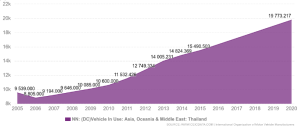
Figure 1. Graph showing a clear and consistent rise in vehicle usage in Thailand from 2005 to 2020
Source: CEIC Data (2020)
Media portrayals of cars as status symbols and government support for automobile companies further fuel car commuting, perpetuating the dominance of car culture, which defeats the purpose of the Clean Air Act. Initiatives like the first car buyer scheme have significantly increased registered vehicles, particularly in Bangkok, while tax incentives favor high-polluting old diesel vehicles, complicating pollution reduction efforts (Marks & Elinoff, 2020; Janssen, 2018). Despite efforts to promote electric vehicles (EVs), it is widely recognized that focusing solely on battery-powered cars does not fully address emission issues. This is exacerbated by the government’s preference to prioritize developing public transportation first, as stated by Chayatan Phromson, Director General of the Office of Transport and Traffic Policy and Planning (OTP) at the Ministry of Transport, who emphasized the need to build better public transportation networks before addressing massive private car usage (DW, 2020).
(4) Deficiencies in Public Transportation Infrastructure
Efficient and accessible transportation options remain a significant challenge, especially in urban areas, potentially defeating the objectives of the Clean Air Act. Even within Bangkok’s robust transportation system, an average train commuter pays approximately US$120 per month, compared to the lower cost of operating private vehicles at US$100 (Pujinda & Yupho, 2017). Ongoing challenges persist with integration, accessibility, and interoperability across the city’s four rail rapid transit systems, exacerbating the reluctance of car users to opt for public transportation (Marks 2020).
(5) Challenges in Holding ‘Untouchable’ Sectors Accountable
Influential sectors like automobile companies and agribusiness corporations have historically dodged accountability by exploiting regulatory loopholes or resisting enforcement, posing a major threat to the Clean Air Act’s effectiveness. These industries use these loopholes to escape oversight, often justifying their actions with claims of supporting economic growth (Ngamkaiwan, 2023). For example, in instances of agricultural burning, companies might even threaten legal action against those who blame them for pollution, refusing to acknowledge their potential role in benefiting from products derived from such practices (Ngamkaiwan, 2023).
Conclusion
While Thailand’s proposed Clean Air Act holds promise for addressing Thailand’s air pollution crisis, it’s crucial to recognize that legislation alone is not a panacea. However, no country that has achieved cleaner air quality has done so without first implementing sensible air pollution policies. The Act’s key provisions, such as recognizing the right to clean air and imposing penalties for non-compliance, offer hope for effective management. Yet challenges persist, including enforcement capacity, impact on marginalized communities, and the promotion of car culture. Therefore, a coordinated effort across all levels of governance is essential to effectively tackle air pollution. This includes implementing sustainable practices, leveraging technological advancements, and fostering increased public engagement, particularly from those directly affected. Such a collective and comprehensive approach is crucial for addressing air pollution issues not only in Thailand but also throughout Southeast Asia.
References:
Baker McKenzie InsightPlus. (2024, January 4). Thailand: Bringing back clean air to Thailand – a new legislation for Air Quality Management approved by the Cabinet. https://insightplus.bakermckenzie.com/bm/environment-climate-change_1/thailand-bringing-back-clean-air-to-thailand-a-new-legislation-for-air-quality-management-approved-by-the-cabinet.
CEIC Data. (2020). Thailand’s Registered Motor Vehicles from 2005 to 2020 [Image]. Retrieved from https://www.ceicdata.com/datapage/charts/ipc_thailand_motor-vehicle-registered/?type=area&from=2005-12-01&to=2020-12-01&lang=en.
Chandler MHM. (2023, December 8). Unveiling Thailand’s Draft Clean Air Act. Thailand Newsletter. Retrieved from https://s3.amazonaws.com/documents.lexology.com/c199c2e3-8d13-477a-b041-6eccf2289172.pdf.
Deutsche Welle (DW). (2020, September 2). Thailand: How to avoid getting stuck in traffic [Video]. Deutsche Welle. Retrieved from https://www.dw.com/en/thailand-how-to-avoid-getting-stuck-in-traffic/video-54716228.
Enano, J. O., & Subingsubing, K. (2019, June 30). Clean Air Act 20 years later: EDSA still “worst place to be.” INQUIRER.net. https://newsinfo.inquirer.net/1135618/clean-air-act-20-years-later-edsa-still-worst-place-to-be#:~:text=Enacted%20in%201999%2C%20the%20law,higher%20than%20the%20acceptable%20values.
Enviliance Asia. (2024). Thailand, Journey to Clean Air Act. https://enviliance.com/regions/southeast-asia/th/th-air/th-journey-clean-air-act.
Jafari, A.J., Charkhloo, E., & Pasalari, H. (2021). Urban air pollution control policies and strategies: a systematic review. Journal of Environmental Health Science and Engineering, 19, 1911-1940.
Janssen, P. (2020, February 18). Bangkok’s bad air driven by car-making success. Asia Times. https://www.asiatimes.com/2018/04/article/bangkoks-bad-air-driven-car-making-success/.
Klimont, Z., & Slater, J. (2024, March 5). Air pollution: The silent killer afflicting Asean’s economy. Asialink. https://asialink.unimelb.edu.au/insights/air-pollution-the-silent-killer-afflicting-aseans-economy.
Marks, D., & Elinoff, E. (2020). Splintering disaster: Relocating harm and remaking nature after the 2011 floods in Bangkok. International Development Planning Review, 42(3), 273-294.
Marks, D., & Lulitanonda, W. (2023, March 12). PM2.5: Endless deja vu in Thailand. Bangkok Post. https://www.bangkokpost.com/opinion/opinion/2526290/pm2-5-endless-deja-vu-in-thailand.
Marks, D., & Miller, M. A. (2022). A transboundary political ecology of air pollution: Slow violence on Thailand’s margins. Environmental Policy and Governance, 32(4), 305-319.
Marks, D. (2020). An urban political ecology of Bangkok’s awful traffic congestion. Journal of Political Ecology, 27(1), 732-758.
Nation Thailand. (2024a, January 18). Lawmakers accept unanimously all 7 drafts of Clean Air Bill. https://www.nationthailand.com/thailand/general/40034803.
Nation Thailand. (2024b, January 21). Srettha lauds Chiang Mai’s victory over Air Pollution, vows continued support. https://www.nationthailand.com/thailand/general/40034889.
Nation Thailand. (2024c, January 30). Thailand’s PM2.5 situation ranked among the world’s worst. https://www.nationthailand.com/thailand/general/40035131.
Ngamkaiwan, C. (2023). Secondary green crime: Bangkok’s PM2. 5 pollution and policy corruption. International Journal for Crime, Justice and Social Democracy, 12(4), 52-65.
Nikam, J., Archer, D., & Nopsert, C. (2021). Regulating air quality in Thailand–a review of policies. Energy, 2015, 2036.
Pujinda, P., & Yupho, S. (2017). The paradoxical travel behavior of Bangkokians. Environment-Behaviour Proceedings Journal, 2(5), 393-402.
Quarmby, S., Santos, G., & Mathias, M. (2019). Air quality strategies and technologies: A rapid review of the international evidence. Sustainability, 11(10), 2757.
Taghizadeh-Hesary, F. (2020). The impacts of air pollution on health and economy in Southeast Asia. Energies, 13(7), 1812.
Vadrevu, K., Ohara, T., & Justice, C. (2017). Land cover, land use changes and air pollution in Asia: A synthesis. Environmental Research Letters, 12(12), 120201.
World Bank. (2022). The Global Health Cost of PM2.5 Air Pollution: A Case for Action Beyond 2021. International Development in Focus. Washington, DC: World Bank. https://doi.org/10.1596/978-1-4648-1816-5.
Author: Rizky Demas Arjunanda
Editor: Hudanur Yildirim